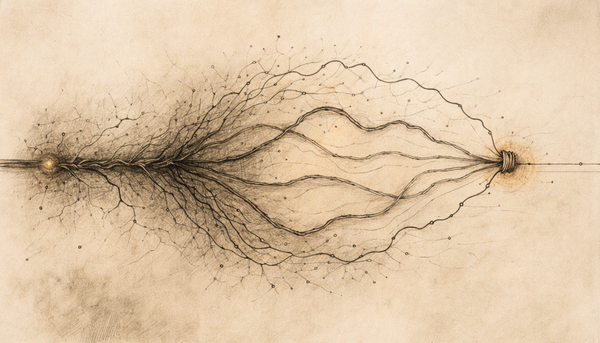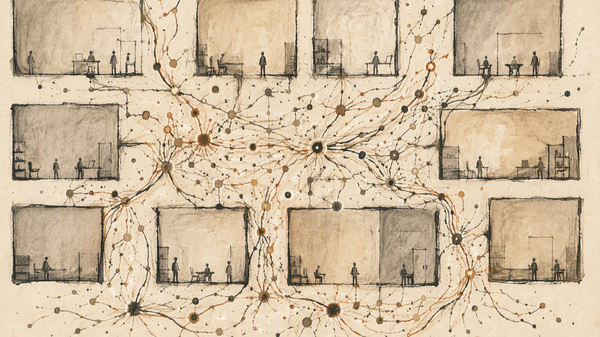
We don't need to manufacture resonance, just stop preventing it.
If you are seeing work described in deliverables and nobody saying why it matters, this article may be for you.


Reproduced from a LinkedIn article from June 2026
Who this is for: If you are seeing work described in deliverables and nobody saying why it matters, this article may be for you.
BLUF: Resonance at work can't be manufactured, but it is often prevented when work is discussed without saying what it is for. Someone has to answer, sincerely, why this matters and to whom: the human version, not the business case.
It's a Crazy Train
Last night I heard Crazy Train by Ozzy Osbourne on the radio: 1980, oh my, I was 16 and had just finished my O Levels and about to go into 6th form to study Maths, English and Physics. I started a computer science subject too, but stopped immediately when the teacher drew a small square on the blackboard while describing computer chips (maybe I should have had more patience with him!).
I remembered exactly where I was the first time I heard it, the feeling of something changing, and it was more than pure enjoyment. One word I could use is resonance (we didn't use that in management speak in the '80s!).
I've had a few of those moments. The first time certain music hit me. Standing in an office in Berkeley Square watching 9/11 happen, hardly able to accept what I was seeing. Waiting at Heathrow with my kids when Ozzy's death came through on the news. The annual explosion of green in spring that somehow surprises me every year.
These moments don't just register; something profound has happened, and they make a difference. But the fact they come out of the blue makes them different, unlike the time you hold your child for the first time.
.. but in the office?
I've had moments like that at work too, although far fewer.
I recall being called into a meeting with my boss with the MD of a direct insurance start-up, and immediately being told to take the meeting and advise what to do. I learned a lesson about being prepared!
One really stands out. I was on a programme called Impact, and Sir Michael Bichard spoke to the room about why we were doing it. He didn't talk about deliverables or success criteria. He talked about Soham, the cost of failing to share information, and the tragic consequences.
The work changed in that moment, and it wasn't just a project anymore.
The moment it catches you
Those moments have something in common. Every single one arrived sideways, and by that I mean I wasn't looking for it. I was just present, listening to the radio, walking into an office, sitting in a room.
Resonance requires that your attention be at rest, not straining toward an experience someone else has designed for you.
Organisations understand that they need people to feel something. They try to create it with the away day, the values launch, and the town hall with the carefully scripted moment of authenticity. They are after resonance, and the motivation is usually pure, but the pursuit kills it.
Bichard didn't pursue anything. He told the truth in a room where people were present. He didn't present the sanitised version and didn't protect the room from the human weight of the work. The impact felt unplanned, although I am guessing it wasn’t, as he is a competent speaker.
Am I allowed to feel things at work?
Not perform engagement or demonstrate passion in a competency framework. But really feel the importance of what the work is for.
For most organisations, the answer is no.
Feeling things is unpredictable and hard to manage. It doesn't fit neatly into a programme update. So, we abstract it and convert meaning into process, purpose into KPIs, outcome into milestones. We get very good at talking about work without ever touching what it's for. That sounds very cynical, but compare the CIO of a financial services organisation talking to people about purpose, slick and meaningless, with Bichard, and the difference is clear, although it is not the context, it is the delivery.
The cost isn't just engagement scores, but the erosion of what makes people bring their full intelligence to a problem; the sense that it matters.
Stop preventing resonance
We don't need to manufacture resonance, but we need to stop preventing it. That means someone who could be a leader, a colleague, or just you, being willing to answer one question clearly and sincerely: why does this matter, and to whom?
This isn't the business-case version; it's the human version.
A lot of the work I've done has had that answer available. The story of who is affected and how is always there, but it rarely gets told in the rooms where the work is designed.
Bichard told it. And I still remember exactly where I was.
And as Ozzy said, "one person conditioned to rule and control, the media sells it, and you live the role". All aboard.....
A note on how I write. The observations, questions and arguments are mine; so is the experience behind them. I work with Claude, an AI assistant, on research and drafting, and I edit and check until I can stand behind each statement. Any errors are mine too.