
Deciding in the fabric. Article 1: Why you decide and where

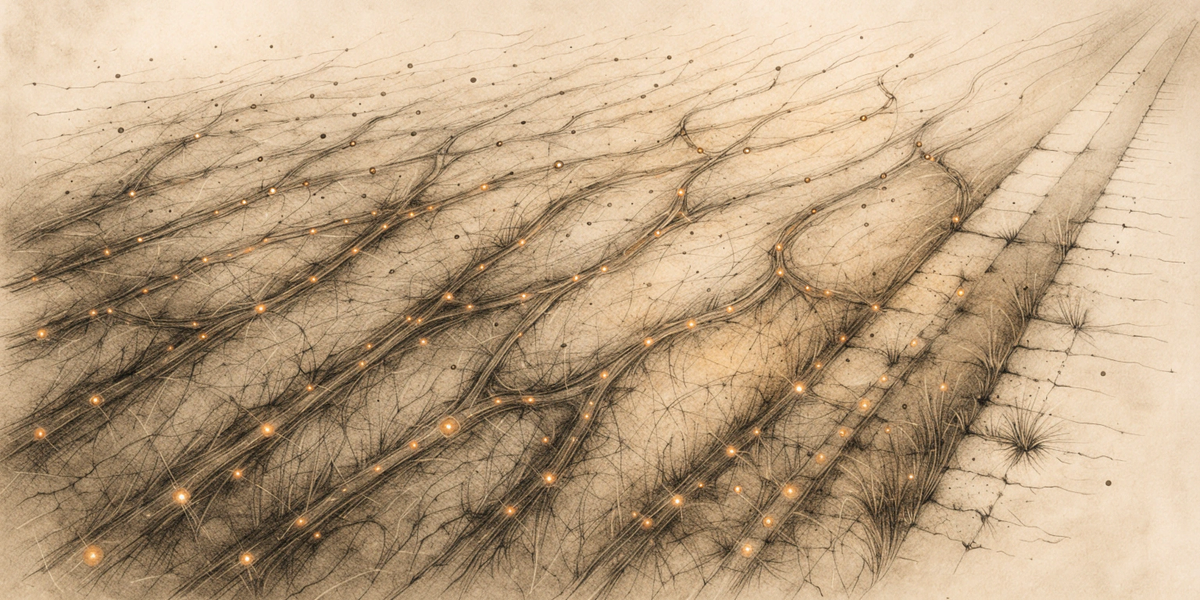
Is this for you: If you are seeing the same kinds of items pushed up to your board or steering group, while the biggest commitments are made in a hurry, this article may be for you.
Bottom line: most decisions in an organisation are never seen as decisions, and that is mostly healthy. A formal decision marks a point where the fabric couldn't settle something, so ask of each item why it needed deciding and where it should have been settled. Keep the centre for the few decisions that are new, contested or irreversible; give those slow thinking before anything is committed and judge the architecture function by how well others decide without it.
Introduction
I had a brief interaction with a new LinkedIn contact a few days ago. He expressed interest in how people, teams and organisations make decisions. I noticed my fabric work hasn't addressed that.
Rather than writing a piece on decision logs, meetings, and all that mechanics, let's think a bit more radically: why are we deciding, and where does this work best? It became three articles; once I started looking, I saw that deciding shows up in almost everything the fabric does.
The aim here is to stop tweaking the mechanics of logs and forums, return to what a decision is for, and rearchitect around it.
Let's start with what a decision is for. The word 'decide' comes from the Latin decidere, meaning 'to cut off'. A decision ends some possibilities so that something else can happen. With unlimited time and resources, you could keep every option open, but because you can't, someone must close some down.
For an individual, deciding is mostly about acting under uncertainty. In an organisation, a second purpose matters more: a decision is a commitment others can build on. Once something is settled, others can plan, spend and hire, and they can stop arguing. Much of a decision's value lies in being settled rather than being right, which is why a reasonable decision made in time usually serves better than a better one made too late.
That purpose hasn't changed, but we organised around it for a very different kind of work.
A model built for bridges
The idea of a design decision as a discrete event, made by an identifiable person and then recorded, comes from a particular kind of work. When Brunel designed a bridge, the decisions were few, large, and nearly irreversible; once the piers were sunk and the iron cast, there was no second attempt. The reasoning lived largely with the engineer, in calculations and notebooks, so the decision, its reasons and the authority behind it were held in one place.
Industrial management kept that approach and used it for people. Taylor separated planning from doing, putting the thinking in an office and the work on the floor, with decisions passed down as instructions. Large organisations built hierarchies of approval on the same pattern of decide at the top, execute below, and record for accountability.
Software inherited the model, and for a while it fitted. Fred Brooks argued in the 1970s that a system needs conceptual integrity, best achieved by a small number of minds, and that the architect as designer of record follows from that. Researchers tried to capture design rationale formally through methods such as Kunz and Rittel's issue-based information systems, but most proved too heavy for everyday use. Architecture decision records, popularised by Michael Nygard in 2011, are a lighter version of the same idea, with a short note for each significant decision, including its context and consequences.
The work has moved beyond the model. Most of what an organisation now builds and changes is the product of many small decisions, taken continuously by many people, and most of them can be reversed. Jeff Bezos distinguishes one-way doors, which require care, from two-way doors, which whoever is closest should take quickly. Our mechanisms were designed for a world where most decisions were one-way doors, and a single designer knew the reasons. They still treat decision-making as a central event, when most of it is now a continuous activity spread across the organisation.
That is why tweaking the mechanics, adopting a better log template, or clarifying the terms of reference helps so little. The underlying model assumes a decision, its reasons, and its authority sit together in one place, and that assumption is no longer true. The more useful change is to return to what a decision is for and rearchitect around that.
Design creates the options, and deciding cuts some of them off, and Brunel did both, so the reasoning that connected them stayed in one head. Once the work spread across many people, it fell apart: design ended up in documents and specialist roles, decisions in forums and logs, and the reasoning that joined them fell into the gap between.
That rearchitects how an organisation decides on a design task. Behavioural economists call it choice architecture: the way a choice is set up shapes what gets chosen, whether anyone intended it. The fabric is an organisation's choice architecture, mostly undesigned. It sets what gets noticed, which options seem reasonable and who feels able to choose. This article looks at it.
Most things are never decided
Most of what an organisation does is not formally decided. Habit, routine, shared understanding and the judgement of those doing the work carry the bulk of it, and there is no meeting to choose. This is the fabric doing its job, settling things through trust and common context without anyone needing to rule out alternatives in public.
A formal decision is needed when the informal layer stops working. Something may be new, interests may conflict, or the stakes may be high enough that someone needs to commit openly; sometimes the informal layer can't resolve it. Seen this way, a formal decision partly signals that the fabric has reached its limit on that question. That isn't the same as something being broken; some questions should come to the centre. It is worth asking which ones did and which ones shouldn't have.
A formal decision is partly a sign that the fabric reached its limit on that question.
Not everything outside the formal process is settled by habit, though; some of it is decided without anyone noticing, through decisions that few recognise as decisions.
Ask an organisation for its design principles, and it will often say it doesn't have any. Yet principles show up every day: in design documents, in the options never considered, and in the habits of those who review the work. They are written in a different form, so nobody reads them as principles.
Each time someone applies one, they decide without treating it as one. The organisation makes these choices the way people walk; it can do it, but it can't describe the mechanics, and it can't examine or protect what it can't describe.
The architect's role here is to read the working principles from the documents and practice and show the organisation what it decides every day. That gives an architecture board something tangible to consider, whether the principles already in use are the ones the organisation wants.
These choices stay hidden partly because of how we think: the mind saves effort wherever it can.
Fast and slow
Why does so much decision-making go unseen? Partly because it is cheap. A hidden principle lets people choose without stopping to think, and most of the time the result is good enough. Daniel Kahneman's work on individual thinking describes the same economy.
His account of two systems of thinking works for organisations too. System 1 is fast, automatic and cheap; it runs on patterns and gets most things right. System 2 is slow and deliberate, and because it costs effort, the mind avoids using it. Kahneman describes System 2 as lazy, tending to endorse what System 1 offers rather than checking it.
An organisation has the same arrangement. Habit, routine and the hidden principles above constitute its System 1, which carries most of the work at little cost. Decision forums are its System 2, which are expensive to convene and slow to act. They are lazy in the same way; a board usually accepts the frame it is handed and works from the summary in front of it, as though what it can see is all there is.
That isn't a criticism of System 1. Gary Klein's work on expert intuition shows that fast judgement is reliable when the environment is regular, and people receive feedback on their calls. In an organisation, that feedback comes from colleagues who will say when a call went wrong, and from a shared memory of what happened last time; both live in the fabric. Experienced teams in a stable setting make good decisions without deliberating, and the fabric is where that experience is built and stored.
The trouble comes when the environment changes and the patterns don't.
Fast judgement keeps producing confident answers to a situation that no longer exists, and the slow system, used to endorsing, doesn't notice.
Many organisational biases are old patterns that were once right. Part of the architect's job is to spot that moment and prompt the organisation to slow down on something it has been deciding too quickly, where that behaviour no longer works. It also explains why losing fabric matters for decisions: when experienced people leave, the organisation keeps its habits but loses the judgement that knew when to depart from them.
If fast judgement settles most things, what reaches the slow system tells you where the fast one couldn't cope.
Read these few paragraphs again. Fast judgement needs watching. Keep checking the quality of the thinking, and notice when it no longer fits the question.
What reaches the centre, and why
The amount of decision-making in an organisation says little about how well it is run. The more useful question is what kind of issue ends up needing a decision, and why the organisation couldn't settle it another way. Ask that of each item reaching a board or steering group, and the answers fall into two groups.
Some reasons are good ones:
- The matter is new, with no precedent or shared understanding to fall back on.
- Interests conflict between groups, and someone with authority over both needs to make the trade-off.
- The stakes are high, or the choice is hard to reverse, so the commitment needs to be made openly.
The others are fabric reasons, and each points to something missing:
- The people closest to it had the authority but not the felt permission.
- Informal agreements don't hold, so a formal decision is needed to make anything stick.
- People want a record to protect themselves, which says something about how blame works.
- It was settled before, but the reasons were lost when the people who knew them left.
- It falls between two areas, and it is not clear whose it is.
The second group is where the fabric shows itself. Each item reached the forum because trust, memory, permission, or a relationship across a seam couldn't handle it. The forum treats it as a decision to be made, whereas the more useful question is what stopped it from being made lower down. A forum full of the first kind is doing its job; one full of the second is compensating for thin fabric, and adding governance will make it busier without making it better.
There is also the opposite question: what should have been decided properly, but never was? Some choices drift, some are made by default, and some are settled by whoever acted first. That is a different fabric failure; nobody felt able to call a halt and choose.
Knowing why things arrive at the centre leads to the question of where they should have been decided instead.
Where deciding works best
If a decision cuts off options so others can act, it works best when those cutting them off can see what is being lost and those who must act can see why.
That usually means being close to the work. The people closest to a problem have the freshest information and feel the consequences first, so they can tell early whether a choice is working. A decision made there needs less translation because its reasons don't have to travel far, and people who work together can build consent more easily.
The centre still has a role, though a smaller one. It is the right place when a choice has no precedent, when it trades one group's interests against another's, or when it commits the organisation to something hard to undo. In those cases, the distance from the information is a cost worth paying for authority over the whole.
Intent-based leadership makes the same argument from the other direction. David Marquet argues that authority should move to where the information is, rather than information moving up to where authority sits, because information degrades on the way up. His model rests on two conditions, competence and clarity, and both are fabric matters.
Clarity of intent only works if people share enough context to read it the same way; competence only gets used if people feel permitted to act on it.
Push decisions down without those conditions, and you get paralysis or inconsistency. Leadership then concludes that delegation doesn't work and pulls authority back. Decisions drift to the centre, regardless of the delegation chart. So the question of the best place for decision-making has a second part: what would need to be true for it to work closer to the work than it does now.
Marquet's examples are operational, for example, an officer telling the captain he intends to increase speed and explaining why. The same approach works for decisions about when to pour the concrete. The authority to commit to a large, irreversible choice may rightly remain at the centre, but the authorship of the reasoning can move to those with the information. "I intend to commit to this platform; here is why, here is what would need to be true, and here is what I would watch" is both a statement of intent and a decision record. The centre's role becomes testing it, asking questions rather than giving orders, and allowing the time that slow thinking needs. What moves is the authorship of the decision, even where the authority stays put.
What moves is the authorship of the decision, even where the authority stays put.
Wherever a decision is made, it must change when circumstances change, and that depends on whether the reasoning behind it was written down.
Keeping decisions adaptable
At a recent BCS conference, a talk titled "Architecting under pressure: when the game changes, can the architecture?" (delivered by Maya Saffron Hanoomansingh of 6Point6) argued that documenting the rationale behind architectural decisions makes an architecture less fragile. That raises an obvious worry about everything above. If decisions move towards the work, and much of the deciding happens in the fabric, do we lose the ability to understand and adapt them when they fail?
A decision is robust when people trust it, it reflects the problem it was meant to solve, and it can adapt as circumstances change. When a decision fails, a team with a record of what it was based on can see which assumption broke, adjust the decision and carry on. A team without that record needs to reconstruct the reasoning first or start again, and under pressure it can do neither and lives with the decision instead.
The worry mixes up two different things: where a decision is made, and whether anyone keeps the reasons for it. Decisions made at the centre lose their reasons too. The fragile decisions are the ones nobody saw as decisions: the hidden principles and the fast System 1 calls. The reasoning was not written down because no one thought there was any. So, the risk isn't pushing decisions out; it is pushing them out without anyone noticing they were made.
Writing down what would need to be true for a decision to hold turns a quick, habitual call into something you can check later. It also tells you when to revisit the decision, which is the basis of working with hypotheses rather than plans, and it lets you correct course quickly when there is no fixed target state to steer by.
A document on its own isn’t the knowledge; it needs people who know the context to make sense of it. A team with shared understanding but no written record has the opposite problem: it loses most of what it knew when two people leave. The record and the fabric need each other.
Writing down the reasoning, the rejected options, and the conditions for revisiting takes time that is rarely seen as valuable output. It is the kind of slack that organisations cut first when they look for efficiency. The impact arrives later, when a decision needs changing, and few can say why it was made. One approach is to give decisions that are hard to reverse or have wide reach a full record, and local decisions a light record, perhaps a line on what was assumed and what would prompt a second look. The intent and guardrails set at the centre are themselves written reasoning, and they are what allow local decisions to be made safely.
All this changes what architects do, starting with the decisions they consider theirs.
The architect's big decisions
Architects like to think they make the high-stakes decisions, the ones an organisation most regrets getting wrong. Some of that is theatre. Architecture review boards look like the place where consequential choices are made. Still, much of what passes through them belongs to the second group above: items escalated for cover, permission, or because ownership is unclear.
I've run architecture boards where a lot of work is happening, yet there's nothing on the agenda. An empty agenda can mean three things.
Decisions are being made where the work is suggests a working system and what you hope for. Maybe they are being made around the board because people see it as slow, risky or irrelevant, which suggests the board has lost its value. Maybe nobody notices there is anything to decide, and choices happen by default, which is the hidden principles at work and the work to create choice and options hasn't been done. Without that design work, there is nothing to choose between, and deciding becomes a formality. From inside the board, you can't tell which, so the test sits outside the room: sample the work, check it against intent, and ask people whether they considered anything and why they didn't.
Meanwhile, the decisions that will be regretted most, a platform commitment or a major supplier, often rest on thin analysis and leadership bias, and are made against a budget cycle or a political timetable. The regard those decisions receive isn't matched by the work behind them. Flyvbjerg's research on large projects captures this well. His advice is to think slow and act fast: plan, test and iterate while change is easy, and commit only when you are ready, because once the concrete is poured, every mistake becomes difficult. Most organisations do the reverse: they decide quickly, under pressure to show progress, then deliver slowly as the problems skipped in planning surface one by one. He attributes the rush partly to psychology, optimism, and the wish to be seen to act, and partly to politics: costs are understated and benefits overstated to win approval, which he calls strategic misrepresentation.
This fits the fast-and-slow pattern above. Organisations often run small, reversible choices through slow forums, while large, irreversible ones either move quickly, with the debate continuing in the background, or are never properly decided. The better arrangement is the other way round: let the fabric settle the two-way doors quickly and give the one-way doors slow thinking before anything is poured.
There is an irony as well. The highest-stakes decisions are often those in which the decision-makers are furthest from the information. The board sees a summary, while the people who know where the risk lies are several layers down, and the summary has been shaped on its way up.
Managing risk in those decisions is much of what architects are for. Take a $100m commitment to a data platform. The question usually asked is whether it is the right technology, and that is the third question to ask, not the first.
The first question is whether the door should be one-way at all. Much irreversibility is chosen, for example, a single large procurement, one migration date, a contract that locks everything in at once. It also spreads in that once a large commitment is made, the decisions that follow inherit it, because changing any of them means reopening the first. Staging the commitment, building in modules and keeping the right to change course help only if each stage can genuinely be stopped or changed. Then the early decisions stay cheap to reverse, and the ones that really are one-way come later, when there is more information. Splitting one contract into phases committed all at once is still one door. Flyvbjerg’s case for modular delivery makes the same point.
The second question is whether the question is right. Asking which platform assumes the organisation needs a platform of that size, that the problem is technical, and that whoever framed it did so well. Framing happens before anything reaches the board, as the second article describes, and the architect is one of the few people with the standing to reopen it.
Only then does the technology choice come into play, and this is where the fabric matters most. The people who know where the risk sits, the engineers who have tried the product, or the analysts who know the data is worse than the business case assumes, are not usually in the room. Their knowledge reaches the board, if at all, through a summary shaped on the way up. Part of the architect's job is to ensure it arrives intact before the concrete is poured, and to document what would need to be true for the choice to hold, so the organisation can tell when it has stopped being a good decision.
This gives the architect a different job:
- Set intent and guardrails clearly enough that the people can make most choices with the information.
- Tend the conditions that let them make those choices with confidence.
- Keep the centre's attention, and proper analysis, for the few decisions that are new, contested or irreversible.
An architecture function measured by how many decisions it makes has this backwards. A better sign is how little needs to come to it, and how well it handles what does.
If the architect's value lies in how little needs to come to the centre, it needs to be demonstrated in some other way than by counting decisions.
Measuring what doesn't happen
That raises a difficult question: how do you value a function by what it doesn't do? It is the same problem as the fabric's, whose value shows mainly when it's gone.
Safety offers a similar example. The traditional approach counts accidents and treats a year without them as success, which tells you little about why things went well, and very little until something goes wrong. Erik Hollnagel's Safety-II shifts attention to why things go right most of the time by studying ordinary work that succeeds. Appreciative inquiry, from David Cooperrider's work on organisational change, takes the same turn: start from what already works and do more of it, rather than diagnosing what is broken. The equivalent here is to stop counting the decisions the architecture function makes and look at the decisions others make well without it.
What is worth collecting as evidence:
- Which items are escalated or put on a board's agenda, why each came there, and whether that mix shifts over time; a fall in numbers alone proves little, since it can mean the same three things as an empty agenda.
- A sample of decisions made locally, checked against intent and guardrails.
- How often decisions, central and local, are reopened or fail to land.
- How long it takes from someone saying, "we have a design problem", or "that decision no longer fits", to it being registered and picked up.
- Whether people can say what they are allowed to decide, found by asking rather than by survey.
None of these makes for a clean metric, and turning them into one would be a mistake. Once fewer escalations become a target, people stop raising issues that should come up, and a new kind of theatre begins.
Some of the value will be seen in stories of what happened rather than numbers: a team that made a good call at the right level, a signal that arrived early, a decision that held because people understood why. Organisations that trust only dashboards will find this difficult, but if the fabric depletes invisibly while the dashboards stay green, a function that tends it will also look idle while doing its most useful work.
Measuring the value is one problem; the other is being clear about what that value is and what an organisation should expect to see when it gets this right.
What an organisation gains when its decision architecture is right
The talk that prompted the section on adaptability asked whether an architecture could change when the game changes. The same question applies to how an organisation decides, and getting the answer right should be evident in ways people can notice, even if it doesn't fit on a dashboard.
The first is adaptability. When reasoning is visible, and decisions sit close to the people who see change first, the organisation can revisit decisions quickly. The organisation corrects course rather than living with choices it no longer believes in, and you'll notice this in how quickly a decision changes once someone sees it is wrong.
The second is engagement. Being trusted with a decision signals how an organisation runs on, and values, trust. People asked only to carry out choices they had no part in often keep their discretionary effort to themselves, and that effort is one of the stocks that drains without anyone measuring it. Where people decide, they own what follows.
The third is the empowerment people feel, not just authority on paper. People feel free to use the authority the organisation says they have, so decisions are made by whoever is best placed, not just by whoever is willing. You would hear it in how people describe what they are allowed to do.
The fourth is earlier warning. People who expect to be asked will tell you sooner, so signals reach decision-makers while there is still time to act.
The fifth is judgement that grows. People learn judgement by making decisions and living with the consequences. Pull every decision to the centre, and you deskill the organisation; when experienced people leave, nobody is ready to take their place. Distributed decision-making is how an organisation grows its own people.
The last is leadership attention where it counts. A centre that no longer processes two-way doors has time to think carefully about the one-way ones, and decisions are less fragile because consent and reasons went with them.
Deciding is the rhythm by which an organisation senses what is happening, commits to a response and learns from what follows. Each decision carries signals in and commitments out, and when that rhythm slows or stalls, everything downstream feels it. It is close to the organisation's heartbeat, and like a heartbeat, it is mostly noticed when it falters.
Closing
A decision is worth making when it settles something others can build on. Most of that settling happens without anyone calling it a decision, in habit, hidden principles and the judgement of people close to the work, and that is mostly as it should be. The centre’s role is to address the few questions the fabric can't settle: the new, the contested, and the hard to reverse. Anything else points to something missing lower down, and more governance will make the centre busier without making it better.
That changes what architects are for. The job is less about making the big decisions and more about setting intent and guardrails clearly enough that others can decide, giving the one-way doors the slow thinking they need, and showing the value of what no longer needs to come to the centre.
If you are a leader, look at your board's agenda and ask why each item came there. Keep the centre's attention on what is new, contested or hard to reverse, and give those slow thinking before anything is committed. Judge the architecture function by how well others decide without it, not by how much it decides.
If you are in the system, notice the decisions you make without calling them decisions: the habits and unwritten rules. When one was made for circumstances that have since changed, say so. If you escalate something you had the authority to settle, ask yourself why. If you escalate something you had the authority to settle, ask yourself why.
If you are trying to improve it, start with the hidden working principles rather than the decision rights. Sample local decisions against intent and guardrails, and before a large commitment, ask whether the door needs to be one-way at all.
Decisions that do reach the centre still have to travel there and then back out.
The second article follows that path.
A note on how I write. The observations, questions and arguments are mine; so is the experience behind them. I work with Claude, an AI assistant, on research and drafting, and I edit and check until I can stand behind each statement. Any errors are mine too.