
The Fabric
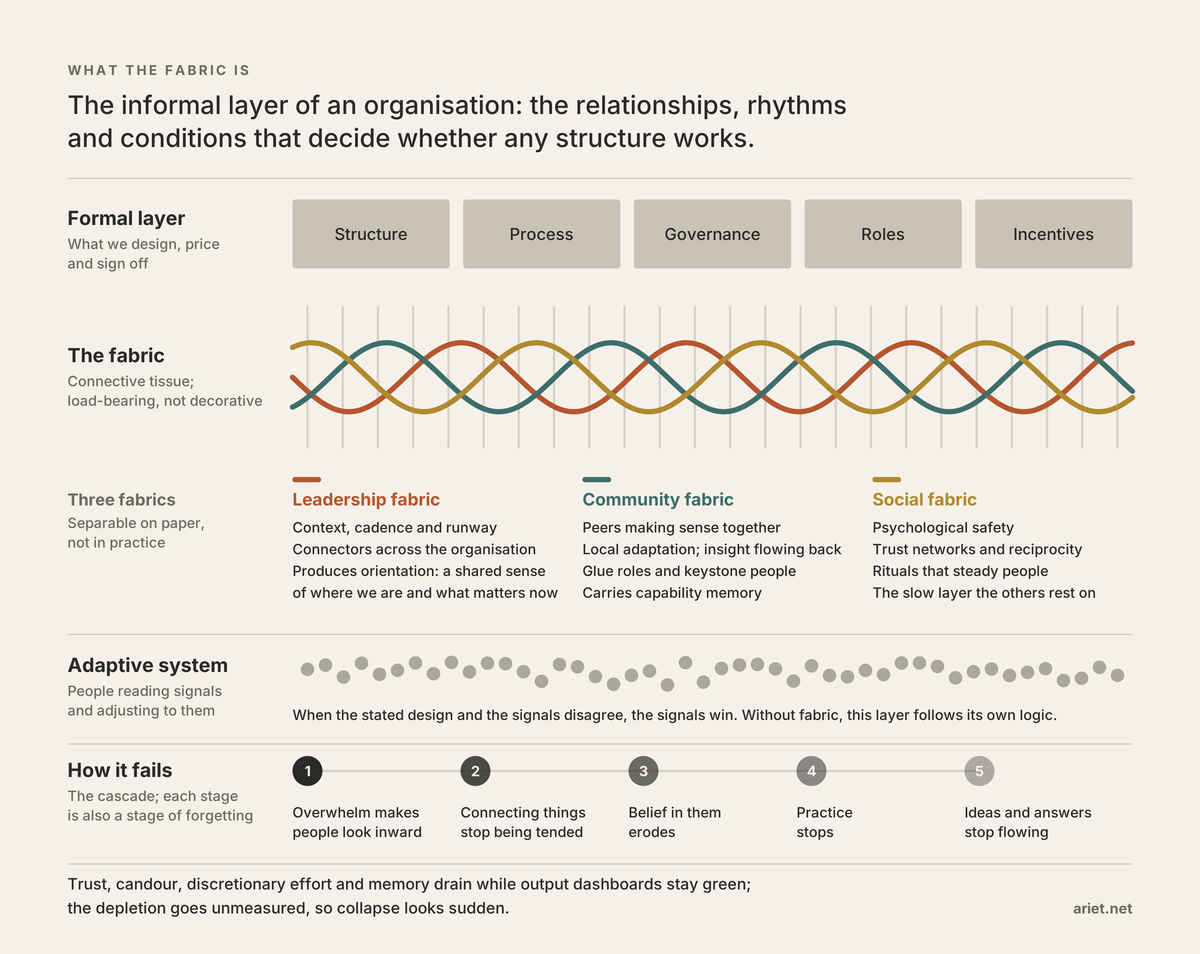
What the fabric is
The fabric is the informal layer of an organisation: the relationships, rhythms, behaviours and conditions that decide whether the formal structure works. It is not culture, governance or values on a wall. It is connective tissue, and it carries load; it is the architecture and structure that makes the organism function.
Two layers
Every organisation has a formal layer; the structure chart, processes, governance, roles and incentives. It is what gets designed, priced and signed off, and it is where most change effort goes.
Underneath it sits an adaptive system: people reading the signals around them and adjusting to what those signals reward. When the stated design and the signals disagree, the signals win. People are not the problem here; they adapt sensibly to the conditions they are given.
The fabric is what holds the two together. Without it, the adaptive system follows its own logic whatever the operating model says. With it, the formal design has something to stand on.
A useful comparison is walking. Most people can walk and can describe the steps, but few can explain the biomechanics. Organisations work the same way. The knowledge of how things get done lives in the system rather than in anyone's head, which is why it is easy to take apart without noticing.
Three fabrics
The book treats the fabric as three strands. They can be separated on paper; in practice each depends on the other two.
Leadership fabric is context, cadence, runway and the connectors who carry information across the organisation. When it works it produces orientation: a shared sense of where we are, what matters now and what good looks like next. Leadership here is not a rank; it exists at every level.
Community fabric is peers making sense of things together, adapting locally and passing what they learn back. Communities carry the organisation's capability memory. Glue roles and keystone people hold them together, and their loss tends to go unnoticed until the community thins out.
Social fabric is psychological safety, trust networks, reciprocity and the small rituals that steady people. It moves slowly, and the other two rest on it.
How it fails
Fabric does not maintain itself. Trust, candour, discretionary effort and organisational memory behave like stocks; they drain while output dashboards stay green. Because nobody measures the depletion, collapse looks sudden when it comes.
It also fails in a recognisable order, which the book calls the cascade:
- Overwhelm makes people look inward.
- The things that connected them stop being tended.
- Belief in those things erodes.
- Practice stops.
- The flow of ideas and answers between people dries up.
Each stage follows from the one before, and each is also a stage of forgetting; what the organisation knew how to do goes with it. Knowing which stage an organisation has reached tells you what it can bear. An organisation deep in the cascade is the wrong candidate for a restructure.
Some of what is lost does not come back. Calling it debt suggests a repayment schedule, and there isn't one. A document written to preserve the knowledge is a postcard from a place you can no longer visit.
The usual responses make it worse. Reorganisations, culture programmes and tighter controls add to the formal layer and leave the fabric to cope on its own.
How I got here
I have been doing target operating model work for decades. For a long time it started with static capability views: connecting strategy to the capabilities an organisation needs, then working out the best way to deliver each one.
That gave a picture of the organisation at rest, so the next step was to put it in motion. We mapped flows and value streams, and how work and value moved from one end of the organisation to the other. It was a better picture, and the operating models that came out of it were better too.
It still wasn't enough. The designs were sound and the programmes ran, yet the organisation that emerged rarely behaved the way the model said it would. What I came to see was that we prioritise the wrong things. We put our effort into what is easy to see and easy to change, because it reassures everyone that progress is being made; it rarely produces the change that was needed. The things that decide whether a change holds sit outside the model altogether. The fabric is my attempt to bring them back in.
Why it gets left out
We design what we can touch and what has a price. The fabric has neither, so it falls outside the brief. It also lets leaders place the duty to change on their people, when it is leaders who set the conditions the fabric grows in.
The book's argument is that the design object is not the organisation; it is the conditions under which connections form and hold. That work is closer to tending than to construction.
A simple test: ask your leaders how your organisation works. What they can describe, they can protect. What they cannot describe, they will dismantle without meaning to.
Read more
The book, The Fabric, is being published here chapter by chapter. Start with the opening, or go to The Book.