Nice posing

I'm getting better with doom scrolling. For example, I don't reach for my phone until I've done all the morning's chores; you don't need dopamine the second you wake. Reaching for it then is like reaching for a glass of Scotch.
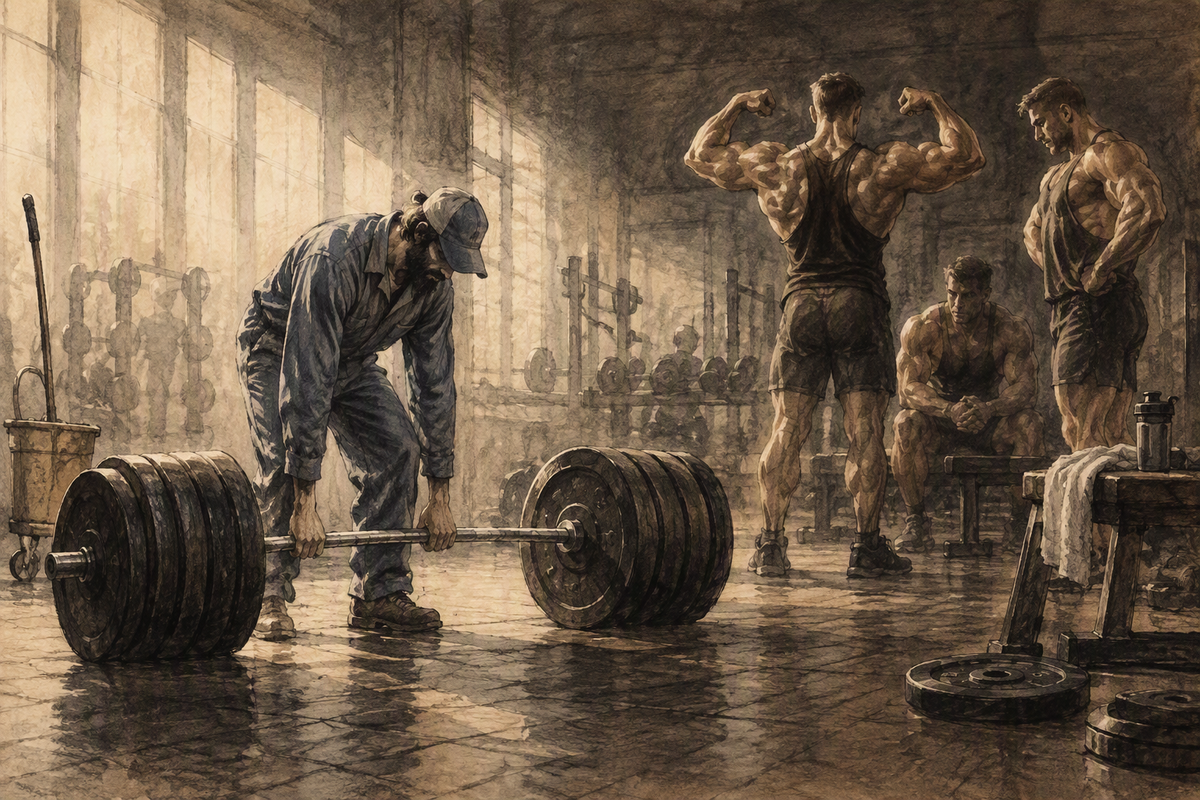
But I still slip sometimes. I follow a guy named Anatoly. His real name is Vladimir Shmondenko, a Ukrainian powerlifter who grew up on a cattle farm in central Ukraine and trained as a teenager in a gym he built from bricks, wood and old tractor parts. He's an ordinary-looking guy who dresses like a janitor at gyms, feigns weakness, then outlifts the big guys. In a recent post, he showed strength without bulk and complimented the guys on their nice posing. It made me chuckle; it was so cutting but delivered so harmlessly.
The joke lands because it reverses expectations. The men with the size look strong; the man in the overalls is strong. I've seen the same thing in organisations for most of my career: quiet competence working away underneath a lot of noise, and the noise getting most of the attention.
Why organisations hear the noise
In most organisations, display gets noticed because the work that holds things up only shows when it fails. The confident voice in the steering group, the framework slide, the long list of past programmes; these are easy to see and easy to reward. So attention, airtime and trust drift towards the people who are easiest to see. Nobody has to intend it. It's how attention works in a busy place where few people have time to look under the surface.
Two kinds of strength
It's easy to sneer at the men in the gym, and it's wrong. Their muscle is real; they built it over years, and it took discipline. It was built for a different purpose. Bodybuilding is about how strength looks, and powerlifting is about what it moves; the two overlap only partly.
Organisations have the same split. Presentation, confidence and a well-made framework are genuine skills, and an architect without them will struggle to be heard. The trouble starts when people mistake them for the ability to carry weight. A team can look strong in every review and still give way the first time a real problem appears.
The poser
I once worked alongside an architect with decades behind him, and he made sure you knew it. Every conversation came round to what he had done and where; very little of it came round to what he would do about the problem in front of us. The experience had stopped being something he used and had become something he wore.
What stays with me isn't the boasting; it's what he did when things went wrong. Work around him was struggling, and he sat back and watched. Something close to satisfaction sat in it, as if each failure confirmed that nobody else met the standard he claimed for himself. He had a reputation for strength and never picked up the bar.
The cost of that falls on other people. Colleagues defer to the experienced voice and wait for it to act. When it doesn't, the work stalls, or someone quieter picks it up, usually without credit, while the poser keeps his standing because no one ever saw him fail. He was never seen to try either, but that is harder to notice.
What quiet competence does when it's tested
Anatoly's routine follows the same sequence each time. He turns up without fuss, looking like the least likely person in the room, and lifts the weight the others couldn't. Then he does what makes the videos worth watching: he turns to the man he just outlifted and praises him.
That sequence carries over to architecture without much translation. Do the work in front of you rather than describing work you once did. Let the result make the point, so you don't have to. And when your approach holds, and someone else's doesn't, leave them a way to stay in the room; credit what they got right and make it easy for them to come with you rather than against you.
Set against the poser, the difference isn't really about ability. He may well have been capable; we never found out. The difference lies in what each of them did when other people were struggling.
What leaders can do
If load-bearing work is hard to see, leaders should go looking for it. Ask people what they did on a piece of work, not what they have done in their career. Notice who carries things when it goes quiet, after one review and before the next. Watch how someone behaves when a colleague is failing; whether they help, stand back, or seem to enjoy it tells you more than any CV.
None of this means ignoring the confident voices, some of whom are strong as well as loud. It means not treating volume as evidence of strength.
Which brings me back to the compliment. Praising another man's posing, and meaning it, takes a particular kind of security; you need to know what you can do well enough that someone else's display costs you nothing. The poser could never have said it, because the posing was all he had.
A note on how I write. The observations, questions, message and arguments are mine; so is the experience behind them. I work with Claude, Google, and Grammarly on research and drafting, and I edit and check until I can stand behind each statement. Any errors are mine too.