Gravitas without distance. Emotion is not the enemy of leadership.
If you are seeing leaders who sound polished and leave the room unmoved, this article may be for you.


Reproduced from a LinkedIn article from March 2026
Who this is for: If you are seeing leaders who sound polished and leave the room unmoved, this article may be for you.
BLUF: Emotion is not the enemy of gravitas; it is part of the social fabric that leadership depends on. Leaders keep gravitas by naming what matters with accuracy and restraint, and lose it when people stop believing the work has human meaning.
“It’s important to make sure that we’re talking with each other in a way that heals, not in a way that wounds.” — Barack Obama
We've seen a lot of President Obama recently. I picked this not because it is particularly relevant, but he is a leader who expresses leadership without hiding from emotion.
I have just started listening to Brené Brown's Strong Ground. I have the book, but I love listening to her read. Her delivery style inspires me. I feel this book is going to inspire many thoughts on human-centred leadership.
At the start, Brené writes about moments of awe in sport or seeing grief portrayed truthfully on stage.
These are experiences that move us, orient us, and remind us that something meaningful is happening.
They aren’t sentimental interludes. They are serious moments, the kind that focus attention, generate energy, and tie people to purpose in ways data rarely can.
I recently had 'the experience' of working for a CIO who led a division of some 50,000 people. He had the well-polished gravitas and a well-trained voice. Captain Picard described a psychology lecturer.... "He just kept talking in one long, incredibly unbroken sentence, moving from topic to topic so that no one had a chance to interrupt; it was really quite hypnotic". I am not speaking as everyone here probably, but occasionally, some emotion, please; can you feel awe in what we are doing? Show it, it is contagious.
In organisations, leaders often avoid these forms of emotion. Awe, grief, compassion, pride, and even hope are treated as dangerous: too expressive, too revealing, too likely to undermine what leaders think gravitas requires. Cultural norms imply that seriousness depends on detachment, that authority rests on emotional distance, and that leadership is most credible when least moved.
But emotion is not a threat to leadership. It is a cornerstone of the social fabric on which leadership depends.
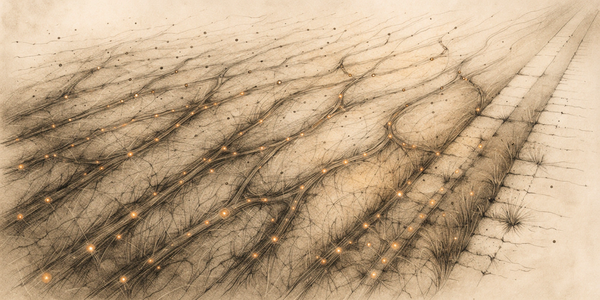
Social fabric doesn’t emerge from values posters, engagement frameworks, or carefully staged town halls. It is created through the day‑to‑day emotional signals people receive: what matters here, who matters here, whether it’s safe to care, and whether meaning is genuinely shared or just ceremonially declared.
These cues accumulate. They form a felt sense of coherence, or a felt sense of fragmentation. Leaders, intentionally or not, shape that fabric through the emotions they allow, ignore or model.
When leaders suppress emotion in the name of gravitas, the cost is not simply a lack of warmth or inspiration; the social fabric degrades. People retreat into role rather than relationship. Brené talks of this, too. She talks about how fear- and shame-based leadership causes people to self-protect, separate from the purpose, and check out.
Work becomes procedural rather than purposeful. Judgement is replaced with compliance because people can no longer read the emotional meaning of what’s happening around them. The organisation continues, but the human orientation that makes complex work possible weakens.
This is especially ironic because the emotions most leaders avoid are precisely the ones that generate positive action.
Awe widens perspective. It reminds people that their work contributes to something bigger than their personal task list. In organisational life, awe surfaces when people glimpse the actual impact of the work, appreciate colleagues' courage, or recognise the ingenuity behind difficult progress. Far from making things “soft”, awe frequently creates the seriousness leaders are aiming for: seriousness rooted in meaning, not formality.
Grief, likewise, is not a derailment. It is a practical force for transition. Organisations shed identities, abandon long‑held ways of working, and let go of ambitions that didn’t land. When these losses aren’t acknowledged, they don’t fade; they immobilise. When named and held proportionately, grief clears the emotional ground for renewal.
Hope is equally misunderstood. In many workplaces, it’s confused with optimism or positivity. But hope is not cheerfulness; it is the belief that a path exists, even if only the next step is visible. Leaders resist expressing hope because it requires naming uncertainty, and leaders love certainty! Yet the absence of hope is far more paralysing than uncertainty itself. Hope is what restores agency. And from Dare to Lead, Brené quotes Rob Bell, “Despair is the belief that tomorrow will be just like today". She describes that as a devastating line.
Belonging, too, strengthens action. Not belonging in the cosy, comfort‑seeking sense, but belonging as contribution: the sense that “I matter here, and the whole would be weaker without me.” When leaders legitimise belonging, accountability deepens. Care deepens. People extend more of themselves to the work because the work recognises more of who they are.
Collective pride, when expressed without ego, is another underused source of organisational strength. It reinforces stewardship and the feeling that what we are building together deserves protection and craft. This kind of pride sustains quality and persistence far more reliably than pressure or metrics.
Finally, in this list anyway (can you extend it), there is compassion: not rescuing but seeing accurately and responding appropriately. Compassion reduces noise and friction by acknowledging the human realities that are shaping behaviour. It doesn’t fix everything; it just makes the system more honest.
These emotions, awe, grief, hope, belonging, pride, and compassion, are not luxuries. They are the threads from which the social fabric is woven. Without them, organisations become emotionally thin and brittle. With them, they can orient, adapt and create meaning even in complexity.
So why do leaders avoid them?
- Partly because they fear emotion can signal a loss of control.
- Partly because the culture teaches that dignity requires detachment.
- And partly because leaders are taught they must be the unshakeable emotional container for everyone else, leaving no room for their own humanity.
Pace, certainty and neutrality become the currency of leadership even when they work against sense‑making.
Gravitas is not, however, emotional absence. It is emotional accuracy, emotional restraint, and emotional purpose.
Leaders with gravitas feel deeply but express selectively. They don’t perform emotion, or centre themselves within it. They name what matters, connect it to shared meaning, and hold boundaries with clarity. They use emotion to widen perspective, not to dominate the room. They create seriousness not through distance, but through disciplined humanity.
This is what strengthens the social fabric. It’s what allows people to trust one another’s intentions, to orient themselves without constant instruction, and to act on judgement rather than fear. Emotional suppression creates brittleness. Emotional stewardship creates coherence.
Emotion without meaning becomes sentimentality. Meaning without emotion becomes sterile. But emotion held with meaning and proportion creates dignity, trust and momentum.
Leaders don’t lose gravitas when they allow themselves to be moved, but they do lose gravitas when people stop believing the work has human meaning.
A note on how I write. The observations, questions and arguments are mine; so is the experience behind them. I work with Claude, an AI assistant, on research and drafting, and I edit and check until I can stand behind each statement. Any errors are mine too.