The blueprint of a complex adaptive system
If you are seeing an operating model that looks coherent from a distance and doesn't work close up, this article may be for you.


Reproduced from a LinkedIn article from May 2026
Who this is for: If you are seeing an operating model that looks coherent from a distance and doesn't work close up, this article may be for you.
BLUF: Built architecture has moved from the heroic architect's finished object towards a working relationship with the people who use a building; enterprise architecture has not followed. Organisations change in layers at different speeds, so a better metaphor is ecology: reading a living system and shifting its conditions rather than drawing a blueprint.
I was reading an article about complex adaptive systems (CAS) and enterprise architecture over the weekend. I thought it incongruous that those two are in the same piece; architecture does not immediately evoke ideas of adaptive systems; it speaks of resilience, strength, and structure. It made me think how the world of work has changed since EA was created.
It is worth pausing on what has happened to built architecture itself since Zachman borrowed its logic.
The discipline has not stood still. If anything, it has spent the intervening decades learning to question the assumptions that enterprise architecture imported and kept.
The heroic architect, the solitary genius reasoning toward an ideal form and then imposing it, has given way, in the more thoughtful parts of the profession, to something more collaborative and humbler.
The people who will inhabit a built space know things the architect cannot know from the outside, how they move through it, what they need at different times, how their use will shift over months and years. The traditional model treated that knowledge as interference with the clean execution of a considered design. The shift is recognising it as material and something to be worked with rather than managed around. The same shift is overdue in how organisations are designed. The lived experience of people inside an organisation, the workarounds they have developed, the informal networks they rely on, the knowledge they carry that never made it into a document, is routinely treated as resistance or cultural drag. It is, more often, the most accurate account available of how the organisation works. Designing without it produces models that look coherent from a distance and quietly fail up close.
Back to buildings, the building as a finished object has given way to the building as the beginning of a relationship. Stewart Brand's work was influential here. Buildings, he argued, are layered systems changing at different speeds (the origin of Pace Layering by the way, not Gartner!), the site over centuries, the structure over decades, the services over years, the interior over months. Good architecture designs for that layering and leaves room for adaptation. It does not mistake the photograph on opening day for the measure of success. And think about that line and how we abandon the commercial contract we make when we deploy; it moves into a world of technical governance, not lived and sustained value.
Brand had a name for the failure mode: magazine architecture. Buildings designed to be seen, not inhabited. Optimised for the moment of completion rather than the decades of use that follow: they look right, but they do not work.
The shift, across all of this, has been from product to process, object to system and blueprint to brief. It is less about "it must look exactly like this" and more "it must achieve these things, for these people, under these constraints, over time."
In other words, built architecture has been moving, slowly and with resistance, toward the conclusion that the building is not the real design object, but the conditions of inhabitation are.
Enterprise architecture borrowed the metaphor at precisely the wrong moment, inheriting assumptions that the source discipline was already beginning to leave behind. If it had borrowed from contemporary architecture rather than mid-century engineering thinking, it might have arrived somewhere considerably more useful.
The irony is instructive: the blueprint metaphor was becoming obsolete in architecture at roughly the same time it was being installed at the centre of how organisations thought about themselves.
Going back to the evolution of enterprise architecture, it was built for a world that organisations were only pretending to inhabit.
John Zachman's framing, which remains the intellectual backbone of the discipline, borrowed its logic from engineering. If you want to change a jumbo jet, get out the blueprints (I recall attending a lecture by him in the 90s, when he said this). Understand the complete structure; map every component and its relationships to every other component. Only then can you intervene with confidence.
It was a compelling idea, and for a moment, when organisational hierarchy was tight, processes were stable, and knowledge lived in systems rather than people, it was useful.
We have surely moved on!
The organisations we inhabit now are not jumbo jets. They are complex adaptive systems and respond to interventions in ways their designers didn't predict. They develop informal workarounds that nobody sanctioned, and nobody can fully see. They learn, forget, and relearn. They are continuously negotiating their own structure from the inside. You cannot blueprint a system that is in the process of rewriting itself.
This is not a criticism of the people who practise enterprise architecture; most of them already know this. The better practitioners have moved away from the blueprint metaphor while keeping the discipline's name. They talk about principles rather than prescriptions, about enabling conditions rather than defined states, about architecture as a conversation rather than a deliverable.
Despite this, the dominant framing, I feel, hasn't caught up. EA programmes still tend to produce elaborate models of the organisation as it was, or as someone wishes it to be, only to be rendered obsolete by the time they are finished, gathering dust in repositories that nobody consults when actual decisions are made.
The problem runs deeper than the method; the metaphor is the issue.
The blueprint metaphor implies a separation between design and execution that doesn't exist in a living organisation. The architect draws, and the building stays drawn, but in an organisation, the people being designed around are also the ones interpreting the design, adapting it to local conditions, and routing around the parts that don't fit. The designed system and the adaptive system are not separate. They are continuously acting on each other.
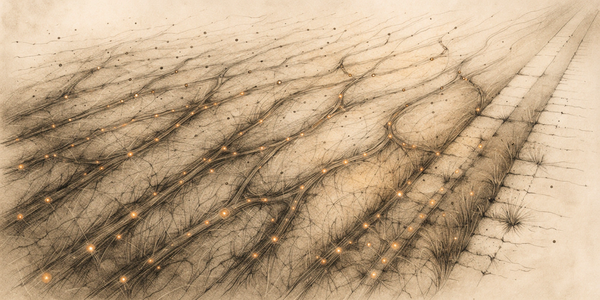
Here is what the blueprint metaphor makes almost impossible to see: the layer that keeps organisations viable is not the formal structure at all. It is something underneath, and you knew this was coming, the connective tissue of relationships, rhythms, behaviours and informal conditions that determine whether the formal design takes root or quietly gets routed around, and I am calling it fabric.
The fabric is what makes a structure inhabitable. It is what allows people to orient themselves, make sense of decisions above them, trust the people beside them, and carry knowledge forward even when the formal model changes. It is what the blueprint metaphor makes invisible, because you cannot draw it, and what you cannot draw you tend not to design.
What would enterprise architecture look like if it took this seriously?
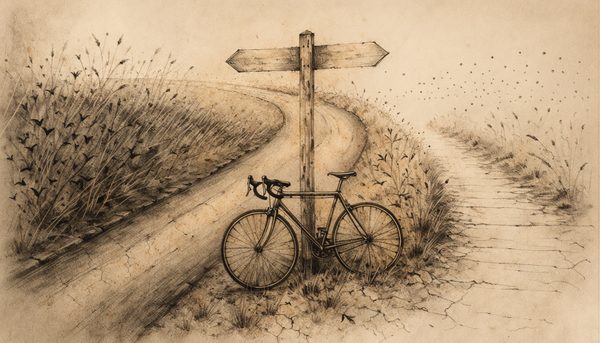
Less like cartography, mapping a territory that holds still, and more like ecology. Understanding how the system sustains itself. Where energy flows and where it gets blocked. What conditions allow certain behaviours to flourish and others to wither. What are the slow-moving layers that protect the faster-moving ones from their own volatility?
The shift is not from rigour to vagueness. Ecology is not less rigorous than engineering, it is differently rigorous. It requires understanding feedback loops, interdependencies, and the conditions under which systems maintain or lose their coherence. That is harder than drawing boxes and lines. It produces different outputs: not a blueprint, but a reading of a living system, and a set of considered interventions designed to shift conditions rather than impose structure. Do I know what this looks like? No, and I am working on that.
Architecture, understood this way, is closer to tending than to construction. The real design object is not the organisation. It is the conditions, the fabric, that keep the organisation viable in pursuit of its purpose.
Zachman's jumbo jet stays where you put it, but an organisation doesn't. The discipline that helps organisations understand and navigate their own complexity needs a metaphor that accounts for that difference.
The blueprint was never quite the right tool, and it is well past time to pick up a different one.
A note on how I write. The observations, questions and arguments are mine; so is the experience behind them. I work with Claude, an AI assistant, on research and drafting, and I edit and check until I can stand behind each statement. Any errors are mine too.