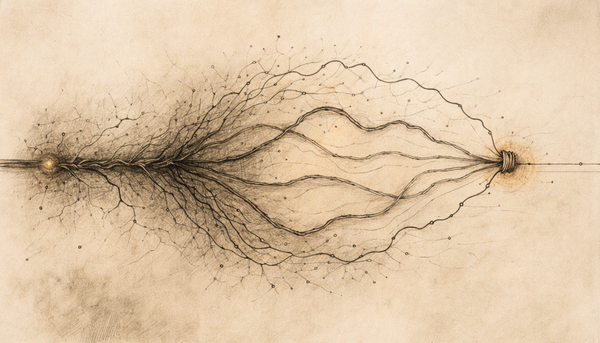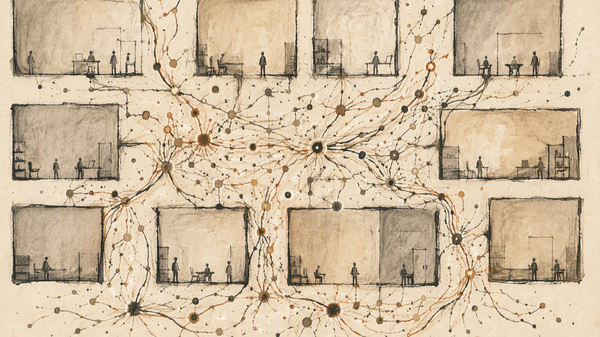
Remembering what is important
If you are seeing long-serving people leave and finding out what they knew the hard way, this article may be for you.


Reproduced from a LinkedIn article from June 2026
Who this is for: If you are seeing long-serving people leave and finding out what they knew the hard way, this article may be for you.
BLUF: Smell and music restore context because memory is encoded with sensory and emotional texture. Workplaces designed to be sensory-neutral produce thin memory, which may be part of why organisations keep losing what they should have kept.
The season of wet, vivid green
This morning I opened the back door of my home in Sheffield, and the smell hit me. Wet green. I love this time of year; so many greens and so vivid. It always happens: suddenly, I was standing on a jetty on the Norfolk Broads forty-five years ago, arriving early for work at a yacht club, the same smell rising of water, trees, grass, and undergrowth.
I have a strong connection to memory, and this was the real thing, not a memory of a memory.
This is not new news and not what I want to write about today. Some quick research suggests the olfactory system has a more direct connection to the parts of the brain that carry memory and feeling than any other sense. It bypasses the relay station that other inputs go through, and smell arrives as memory before it arrives as information. I find a similar effect with music, and music does something related, encoded with emotional and temporal context in a way that retrieval is unusually rich and specific. You don't remember just the song; you are briefly back inside the time that contained it.
We get this constantly outside work. The quality of light in October. A piece of music from a specific year. The smell of a place you haven't visited in decades (I used to visit an uncle on an RAF base in Peterhead, and the smell of Wright’s Coal Tar soap reminds me of it). These things don't just remind us; they restore context, relationship, and an experience, sometimes all in vivid colour.
So why does the office have no smell?
Most professional environments are usually designed to be sensory-neutral. The logic is that neutrality is professional because strong sensory environments distract. The result is that nothing gets encoded with distinctive sensory context, and nothing is retrieved that way either. The environment produces generic memory or no memory at all.
There's something deeper here, I think, although this may be a very personal perspective. though. Most organisations carry an implicit theory of knowledge that treats explicit, transferable, documented information as the real thing and the stuff that counts. Think of how many initiatives have focused on getting people to share more documents. Everything else that is a document is noise. Sensory encoding, emotional context, and the quality of a particular conversation in a particular room don't fit this model. You can't put them in a SharePoint or extract them from a leaver's laptop.
I've been thinking and writing about this elsewhere under the heading of memory as capability. This is the idea that what organisations know how to do lives primarily in their communities, in the conversations and practices, and relationships that constitute working together, and that when those communities thin or break, the knowledge goes with them in ways that documents cannot recover. It’s like a document as a photograph of a meal. It contains data, but doesn't give you the taste, or the chat that happened, or the way the meal paired with the wine.
Leaders want communities to be effective at sharing documents, but we need them to be so much more.
What the sensory question adds to this concerns encoding and retrieval. The knowledge worth keeping isn't just facts and procedures; it is contextual, relational, and embodied. It was formed in a specific place, among specific people, in conditions that carried their own texture. Strip the conditions, and the knowledge becomes thinner, harder to access, easier to lose.
So what next
I'm not sure what the practical implication is. I'm not about to recommend scent diffusers as an organisational design intervention, but I am sure there are implications. Maybe the best communities exist in organisations that don’t suppress the memories.
We have built environments that are easily forgettable and then wondered why people don't remember what matters. We have stripped out the texture that encodes experience, only to be surprised when experience doesn't transfer. We have treated the informal, sensory, relational dimensions of working together as distractions from the real work and then found ourselves unable to explain why organisations keep losing things they should have been able to keep.
The back door in Sheffield is still open, the cats are watching the drizzle, there are patches of blue sky, and it still smells of wet green.
This connects to a longer piece I've been writing on memory as capability — the argument that communities are the primary carriers of organisational knowledge, and that when they stop meeting, something is lost that documents cannot recover. It can be found here.
A note on how I write. The observations, questions and arguments are mine; so is the experience behind them. I work with Claude, an AI assistant, on research and drafting, and I edit and check until I can stand behind each statement. Any errors are mine too.