Organisational ghost towns: why change delivers places nobody lives in
If you are seeing people go through the motions of a design the board signed off a year ago, this article may be for you.


Reproduced from a LinkedIn article from July 2026
Who this is for: If you are seeing people go through the motions of a design the board signed off a year ago, this article may be for you.
BLUF: New cities and new operating models often fail not because they are new but because they are complete; every space and interaction has its purpose decided in advance, so there is nothing left for people to make their own. Completeness persists because it is what sponsors buy, so sponsors should commission conditions rather than conclusions, and designers should leave room on purpose and say where.
Geoffrey West on new cities in his fabulous book Scale says:
“Many of these new cities are soulless ghost towns with little sense of community. Cities have an organic quality. They evolve and physically grow out of interactions between people. The great metropolises of the world facilitate human interaction, creating that indefinable buzz and soul that is the wellspring of its innovation and excitement, and a major contributor to its resilience and success economically and socially. It is short sighted and even courting disaster to ignore this critical dimension of urbanisation and concentrate only on buildings and infrastructure”.
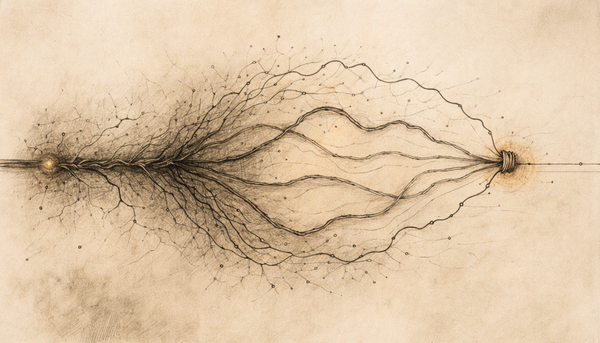
The physicist Geoffrey West has spent years studying what makes cities work. His conclusion is uncomfortable for anyone who builds things for a living: the value of a city lies not in its buildings or its infrastructure, but in the density of human interaction they make possible. Cities are superlinear; double the population, and you get more than double the innovation, the wages, the ideas. The physical city is only the stage; life runs on the network.
West worries that we now build cities faster than that network can grow. As in the quote, he observes that new cities and classic suburbs are often soulless ghost towns with little sense of community, and we do not have 150 years to wait for one to develop.
He is right about the timescale. Washington DC took most of a century to become a place anyone would choose to live. L'Enfant's plan was a masterpiece on paper: grand avenues, deliberate sightlines, a capital drawn as a diagram. Visitors mocked it as a city of magnificent distances, all boulevards and no life. What eventually made it a city was nothing in the drawing. It was U Street growing up around a segregated community's own institutions, Howard University producing an intellectual elite the founders never imagined, and Ethiopian restaurants colonising a street nobody official was watching. The fabric grew in the gaps the plan left open, among people the plan had ignored.
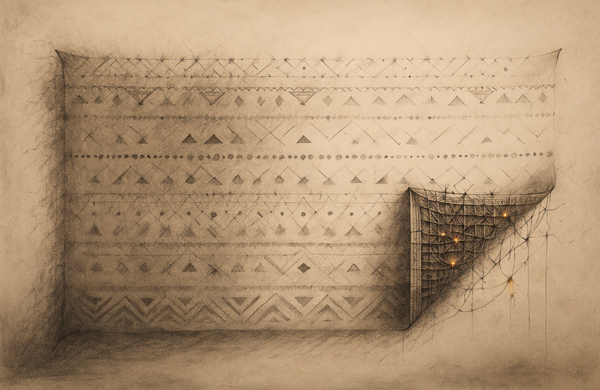
That is the point of this piece. When new cities struggle, it is rarely because they are new; it is because they are complete. Every space has a designated purpose; every interaction has a designed channel; every square metre has been decided in advance. There is nothing left for people to appropriate, nothing underdetermined enough for a community to make its own. Songdo and Brasília are not unfinished cities waiting for life to arrive. They are finished cities in which life has little opportunity to take hold, and I’m not going to talk about Milton Keynes! (ok, a little harsh).
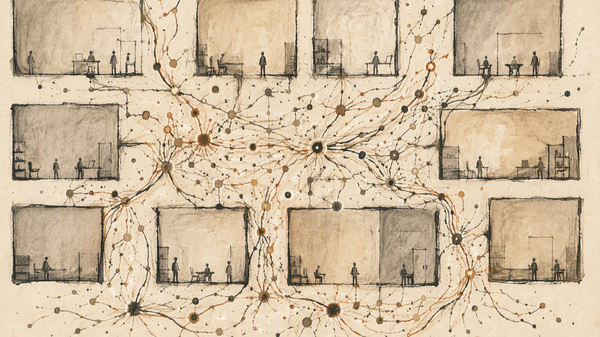
Organisations make the same mistake, for the same reasons, with the same confidence. We design the operating model, the interaction patterns, the collaboration tooling, the engineered moments of connection, and we call the result culture. It is Songdo. Complete, legible and dead. Every transformation has its ta-da moment, when the deck with all the drawings and decisions is finally delivered; and in that instant everyone in the room becomes a recipient of the design rather than a participant in it. Few take up a finished drawing and then we wonder why nothing grows in organisations where people interact all day, but every interaction arrives with its purpose already assigned, and culture only forms in the ones that don't.
Back to the physical metaphor, MIT’s Building 20 worked here, although by accident. It did not work because it forced collisions, but because the collisions had no assigned purpose; what happened in the corridor was up to the people in it. As a temporary building, people adapted it to make it work because the building had no architectural dignity to protect.
West says we cannot wait 150 years. This is true, but the choice is not between waiting and doing nothing. Washington's fabric was not slow because fabric is slow. It was slow because it grew despite the plan, through war, migration and exclusion. Where the conditions are right, fabric grows quickly; every allotment society, every open source project and every trading floor demonstrates it. West frames it as a problem of time, but time is not the important ingredient. Fabric grows where the conditions let it, and conditions, unlike time, are something a designer can provide.
It would be comfortable to treat completeness as a designer's defect, but designers mostly know better; the good ones within the built world have been arguing for looseness and unfolding for fifty years. Completeness persists because it is what gets bought. A business case wants the target state fully specified; a board signs off on certainty, not conditions, and a designer who presents an unfinished drawing looks as if they have not finished. The ta-da deck is not a failure of design judgement; it is a contract being honoured between a sponsor who buys finished and a designer who has learned that finished is what sells. Nothing changes until the contract does.
So, this is a call to action, and the action is a discipline of restraint when designing an organisation, or a city, or anything meant to hold people.
If you are the sponsor, change what you are buying. Commission conditions, not conclusions. Accept that a design with room left in it is not undelivered scope; it is the part of the work that only your people can do, deliberately left for them. Stop treating the ta-da moment as the moment of value; it is usually the moment the thinking stops.
If you are the designer, stop selling certainty that you know is false. Every over-specified target state teaches the sponsor to expect the next one. Leave it incomplete, and make it clear where and why; protect the slack; do not decide in advance what matters; and when you find life already growing somewhere your design did not put it, leave it alone.
None of this compresses 150 years into five. But it is the difference between a place where fabric can grow and one where it structurally cannot. West is right that concentrating only on buildings and infrastructure is courting disaster. The answer is not to engineer community harder but to make the decisions that let the fabric grow, and then to hold your nerve while it does.
A note on how I write. The observations, questions and arguments are mine; so is the experience behind them. I work with Claude, an AI assistant, on research and drafting, and I edit and check until I can stand behind each statement. Any errors are mine too.