It's all about people
If you are seeing a strategy that is clear at the top and isn't landing anywhere else, this article may be for you.


Reproduced from a LinkedIn article from March 2026
Who this is for: If you are seeing a strategy that is clear at the top and isn't landing anywhere else, this article may be for you.
BLUF: Organisations don't do transformations; people do, one constrained choice at a time. Leaders reconnect with that not through town halls and visits but by spending time where trade-offs are made and asking what the system forced people to choose between.
I used to get a lot of my leadership thoughts from Jean-Luc, but surprisingly, a lot of it is coming from Buffy the Vampire Slayer at the moment! Although seriously, like comedians, we see humour in everyday events, I think we can see leadership in them too.
Hannah has been away again, so I get to binge on my TV. Last night it was Buffy again. This caught my attention. Parker, who turns out to be a total shit, is talking about his interest in history, about what he calls "huge events", but it is not the events that fascinate him.
“There’s something amazing about these huge events, that when you dig down into them, they’re all about people. Just regular people just trying to make choices. When you look back on it it seems like people were swept up in events they couldn't conttrol. But I don't believe that, you always have a choice with everything you do.” Parker, Buffy the Vampire Slayer, S4 E3 (The Harsh Light of Day)
People, swept up in huge events, having to make the best choices they can.
That’s the human‑centric operating model argument in a nutshell: organisations don’t do transformations, people do, one constrained choice at a time.
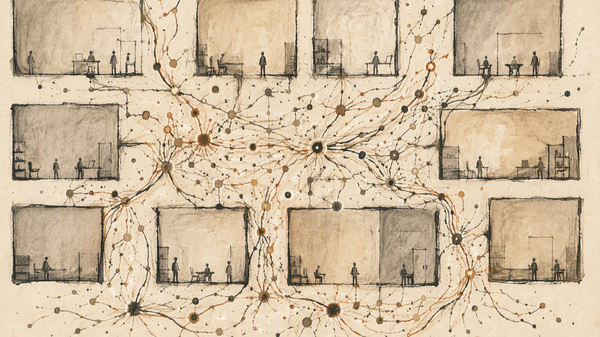
The big event (strategy, restructuring, crisis, programme) is just the surface narrative. Underneath, the system is made up of thousands of micro‑moments in which someone is trying to orient themselves, decide, and act with incomplete context and limited control.
When leaders design as if outcomes can be engineered top‑down, they accidentally erase those moments and with them, the real levers of performance: clarity, safety, time, authority, feedback, and removing friction.
Leaders often don’t get it because the system buffers them from lived constraint and rewards abstraction. Reconnection isn’t a pep talk; it’s a design choice: spend time where trade‑offs are made, listen for constraint, not opinion, and treat leadership as shaping conditions rather than authoring outcomes.
In practice, that means fewer theatrics (visits, town halls, cascades etc) and more contact with reality: shadowing work, tracing decisions end‑to‑end, and asking the only questions that matter:
What made this hard, and what did the system force you to choose between?
That’s how you stop designing for the headline and theatre and start designing for the humans who have to live it.
You can look forward to some more '90's TV leadership nuggets the next time I am alone with the sofa and the TV remote!
A note on how I write. The observations, questions and arguments are mine; so is the experience behind them. I work with Claude, an AI assistant, on research and drafting, and I edit and check until I can stand behind each statement. Any errors are mine too.