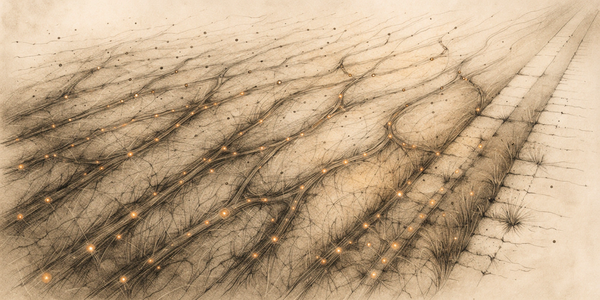
The operating model behind the operating model
If you are seeing a reorganisation that was signed off a year ago and an organisation that still works the old way, this article may be for you.


Reproduced from a LinkedIn article from May 2026
Who this is for: If you are seeing a reorganisation that was signed off a year ago and an organisation that still works the old way, this article may be for you.
BLUF: An operating model designs a thin layer of formal behaviour; most of what decides how the organisation behaves sits in the informal layer we don't design. The mechanisms you already run, such as governance cadence, leadership rituals and communities, shape that layer either way, so the first question is whether they keep the model viable or only keep it visible and controllable.
Why operating model work often fails to deliver sustainable value
Most operating model work follows the same pattern. The strategy sets the direction, capabilities are mapped, and value streams are drawn. And then the conversation lands on the organisation because that is where executives instinctively place responsibility for change. The new model is signed off, the reorg is announced, and within a year, the operating model on paper and the organisation in motion are different things. Sometimes this can be visible to executives, and the change is laden with disappointment and strengthening distrust of this sort of activity. It’s usually visible to the workforce that nothing has changed, apart from the slogans, and the ever increasing confusion about what is important.
What else is happening? Targets drive behaviours that degrade the system, coalitions form, and norms emerge that no one specified. Local optimisation strays from enterprise intent, and (as many systems thinkers predicted) the organisation starts doing what it does, not what it was designed to do.
This is usually framed as an execution, culture, or leadership problem. Maybe followed by ‘culture resets’ (what leader ever thought that a culture can be reset!) But it is a design problem, but not in the layer we have been designing.
What we design, and what we don’t
When we draw an operating model, we are designing a thin layer of formal behaviour: structures, processes, incentives, governance, and accountabilities. That layer is necessary. It is also a small fraction of what determines how the organisation behaves once it meets real people, real customers and real conditions.
The rest is adaptive as people pursue their own interests, sensibly and sometimes not. Information moves through informal channels faster than through formal ones. Norms that nobody wrote down become more binding than policies that were carefully drafted. It is what human systems do, and an operating model released into an organisation becomes part of an adaptive system that does not particularly care about the design intent.
We cannot design our way around this by adding more formal layers; processes, governance, dashboards etc. The response of most operating models to drift is to thicken the mechanical control. It works until it doesn’t, and when it stops working, nothing beneath it knows how to reorient the system.
The missing layer
There is a layer between the formal model and the adaptive system underneath it. I am calling it a fabric, although I am not sure if I picked that up from somewhere else. It is the conditioning system that keeps capabilities, value streams and the organisation oriented to purpose despite the constant destabilising pressure of human adaptation and self-interest.
Fabric is not slogans and values on a wall, nor is it culture in the soft sense. It is the connective tissue of the operating model: the rhythms, behaviours, relationships and informal conditions that determine whether the formal design functions. It is load bearing, and it materialises in three forms that work together.
To understand why fabric is necessary at all, it helps to consider what distinguishes an organisation from a natural ecosystem. Natural ecosystems are self-conditioning. The feedback loops that keep them viable, e.g. predator-prey dynamics, nutrient cycles, and climate regulation, were not designed. They emerged because systems without them didn’t survive. Viability was the selection mechanism, and continuation was the only aim. No purpose was imposed from outside.
Organisations are different in one way that changes everything. Purpose is placed on them. An organisation exists to do something, to serve customers, deliver a mission, generate value, and that purpose is not something the adaptive system naturally tends toward. The superorganism underneath will tend toward its own continuation and interests, which is not the same thing. In a natural ecosystem, the conditioning is intrinsic; it evolved with the system. In an organisation, it has to be designed, because the purpose we have imposed is not one the system would have chosen for itself.
This is what the fabric is for, and it is what defines the shift in thinking that follows.
Three fabrics
Leadership fabric
This is what leaders do to keep the system coherent. It is making strategic priorities visible and the rationale for decisions explicit, so that people downstream are not left guessing why. It is about maintaining a reliable cadence of forums that allow the organisation to surface what is happening, rather than waiting for it to appear in the numbers. It is managing the runway: protecting the organisation from overload, limiting work in progress, and sponsoring early truth over reassuring optics. And it is actively and visibly supporting the people who connect across boundaries, because they are doing the work that the org chart does not show. My recent experience is that these are the people most at risk of cost-cutting, the glue roles that are rapidly sacrificed when the market says times are tough.
Without a leadership fabric, there is no coherent signal at the centre. People read the gap between what is said and what is done and adapt to it. The formal model becomes a decoration on top of whatever the adaptation produces. What people need to work well is orientation — a clear enough sense of what matters, why it matters, and what the next move is. Leadership fabric is what makes orientation possible. Without it, even capable people in well-designed structures become uncertain, cautious, and overwhelmed.
Community fabric
This is how people work together day to day across the organisation’s formal seams. It is a shared orientation around what is being done and why. It is peer sense-making; the conversations between professionals that surface patterns and test emerging ideas and truths before they reach a steering committee. It is the existence of clear norms for early escalation and decision practices that distinguish what is local from what needs to be shared. It is local adaptation rights within agreed boundaries, so that people closest to the work can adjust without breaking the enterprise intent. It is the flow of insight from the work back into the governing rhythms, so that what is learned changes what gets decided.
Without community fabric, each person and team navigates alone. The result is fragmentation, workarounds, and the gradual disappearance of what was designed.
Social fabric
This is the climate produced when leadership and community fabrics are doing their work. It is psychological safety that lets problems surface before they become crises. It is trust and informal networks carrying the information that formal structures miss. It is a sense of fairness and equity that allows people to commit to change without bracing against it. It is shared meaning that is felt rather than communicated. It is a reciprocity norm in which change is everyone’s job, not something done to one part of the organisation by another. And it is the stabilising rituals, the check-ins and retrospectives etc, that allow the system to absorb destabilisation without people themselves having to absorb it as overwhelm.
Without social fabric, structural change produces anxiety rather than energy. The result can be burnout, attrition and disengagement before it shows up in performance.
These three are not separable in practice. Leadership fabric without community fabric becomes top-down direction that doesn’t translate. Community fabric without social fabric becomes pockets of energy that cannot connect. Social fabric without leadership fabric is goodwill with nowhere to go. Nurtured together, they keep the operating model viable while it is in motion.
The inversion
What is the unexpected but key message from this?
The conventional view says that we should design the operating model and hope the human stuff works out. Fabric, in that view, is a wish — something we’d like to have, that hopefully shows up if we hire well and lead well.
The alternative view inverts this. We have been trying to design the ecosystem — the structures, the capabilities, the flows — as if the right arrangement of parts would produce the right behaviour. But the adaptive system underneath will do what it does regardless. The layer we have genuine agency over is the fabric: the conditioning system that holds the organisation toward a purpose it would not naturally serve. The formal model is the artefact; the fabric is the system that keeps the artefact alive.
This changes what the architect’s job is and what executives should commission when they ask for architectural work. The architect’s real design object is not the organisation. It is the conditions that keep the organisation viable as it pursues its purpose. Architecture, properly understood, is closer to tending than to construction.
A practical implication follows: structural change imposed on a weak fabric tends to produce the appearance of new ways of working without the reality. Pods, squads, matrix structures, and target operating models all depend on at least a minimum viable fabric being in place. The instinct to reorganise first and let the fabric catch up is what produces the drift between the model on paper and the organisation in motion. Fabric work is not a follow-up phase. It runs alongside and, in places, ahead of structural change.
Why this explains so much
The inversion explains a list of disappointments most executives will recognise.
It explains why reorgs often disappoint. They redesign the layer that adapts anyway, while leaving the conditioning layer untouched or actively damaged.
It explains why culture programmes without a structural fabric fail. They are aimed at the right layer with the wrong tools as slogans, posters and away-days cannot create what only leadership behaviour, community structure and social norms can.
It explains why mechanical control feels productive and ends badly. Pipelines, dashboards, and tightly coupled processes substitute for fabric. They work until conditions shift, and then there is nothing left in the system that knows how to reorient.
And it explains why some organisations weather genuine shocks, leadership changes, market disruption, and strategic reversals, while others fragment under far smaller pressure. The difference is rarely the formal model; it is whether there was a fabric underneath it that was doing the conditioning work all along.
What changes for executives
If fabric is the real design object, three things shift in how operating model work is sponsored and judged.
There is also something more difficult to acknowledge and this is that the operating model work executives commission is rarely about themselves as it should be. Most systemic degradation, inconsistent priorities, slow decisions, filtered truth, and eroding stabilisers are produced by leadership behaviour, not workforce failure. People adapt rationally to the conditions they are given. If the fabric is weak, the place to look first is what leaders are doing and signalling daily, not what the structure says on paper.
Most operating model reviews ask whether the organisation is operating inside the model. The better question is whether the organisation has more capacity to handle context, complexity and change than it had a year ago. Capacity is built in the fabric, not the formal model, and like the glue roles (yes, I feel strongly about this), capacity is designed out of the system as pipelines become priority.
A great deal of operating model design implicitly treats people as the source of drift, and as the thing the model must constrain. Fabric thinking treats people as the carriers of the conditioning system itself. The work of architecture becomes growing the contextual judgment of leaders and the strength of communities, not substituting for them with process.
Mechanical control becomes the last resort, not the first. When something is going wrong, the instinct is to add control. The fabric question is what conditioning has been lost, and whether the right response is to restore it rather than overlay more mechanisms.
Mechanical control is cheap to add and expensive to live with. Fabric is expensive to build and cheap to live with. Oh dear…. I have created a slogan for a poster!
Where this leaves us
The discipline most organisations call enterprise architecture has spent a long time defending the formal layer: the capability map, the value stream, the target operating model. That work does matter, but it is not the whole job, and on its own, it does not explain why some organisations stay viable in motion, and others do not.
The organisations that do stay viable are probably not doing so by design. They stumbled into conditions, the character of their founders, the weight of a mission that genuinely preceded the organisation, a founding culture that happened to produce trust across seams and that generated fabric without anyone designing it. These are leaders who orient their people through context rather than instruction because that is simply how they lead. Communities that formed around craft or purpose before the org chart told them to. Social conditions that allow bad news to travel upward quickly because the alternative never felt acceptable.
These are not replicable by imitation. You cannot copy the founding conditions of an organisation that got lucky with its leadership, or that built something people genuinely believed in before scale and process arrived. What you can do is understand what those conditions were producing and build it deliberately when the luck runs out.
And it does run out when leadership changes, or the founding mission gets institutionalised, and it gets separated from the daily work of most people and stops doing the conditioning work it was doing. Scale introduces seams that the original culture never had to cross. Organisations that were once coherent without trying, become incoherent without understanding why.
That is the moment fabric becomes visible, not because it has appeared, but because it has gone. The organisations that fragment under pressure are rarely those that never had fabric. They are ones that had it accidentally, lost it gradually, and had nothing deliberate to fall back on.
The whole job includes tending the fabric: the leadership behaviours that create context, the communities that carry standards across the seams, and the social conditions that let the system absorb destabilisation without breaking the people inside it. That layer is where viability lives. Designing the structure without cultivating the fabric is building on ground that will not hold.
The architect’s real work, and the work executives should be commissioning, is making the conditions for viable organisations deliberately reproducible. Built, tended, and understood well enough to be rebuilt when it erodes.
But first, a question for leaders
There is a problem that sits before any of this becomes useful, and it is worth establishing now.
Most leaders in my recent experience are moving in the opposite direction. The pressure to show control, reduce cost, and demonstrate delivery pushes toward exactly the pipeline thinking this article has been arguing against. That is not irrationality; it is a rational response to the conditions leaders are in but it means the fabric argument lands at precisely the moment leaders are least likely to receive it.
This is not a debate about additional cost. Every organisation already has the mechanisms: forums, governance cadence, leadership rituals, community structures of one kind or another. The question is not whether to have them, but what they are pointed at. Mechanisms aimed at reporting and control condition the system toward compliance and appearance. Mechanisms aimed at viability condition it toward orientation, adaptation, and honest signals. The cost is probably similar (except for where an organisation has already removed glue roles), but the outcome is not.
So, before any framework for designing fabric is useful, there is a prior question worth pausing on. Are the mechanisms you already have keeping your operating model viable, or just keeping it visible and controllable?
You would know the fabric is doing its work when problems surface before they become crises, when the gap between what leaders say and what people do is small, and when the organisation reorients after a shock rather than fragments. None of that requires measuring fabric directly. It is what fabric produces when it is working, and its absence is what you are already seeing when it is not.
Are you willing to find out?
That is where this work goes next, and to be honest, at the moment, I don’t know what that is.
A note on how I write. The observations, questions and arguments are mine; so is the experience behind them. I work with Claude, an AI assistant, on research and drafting, and I edit and check until I can stand behind each statement. Any errors are mine too.