What a book of Turkish poems suggested to me about architecture
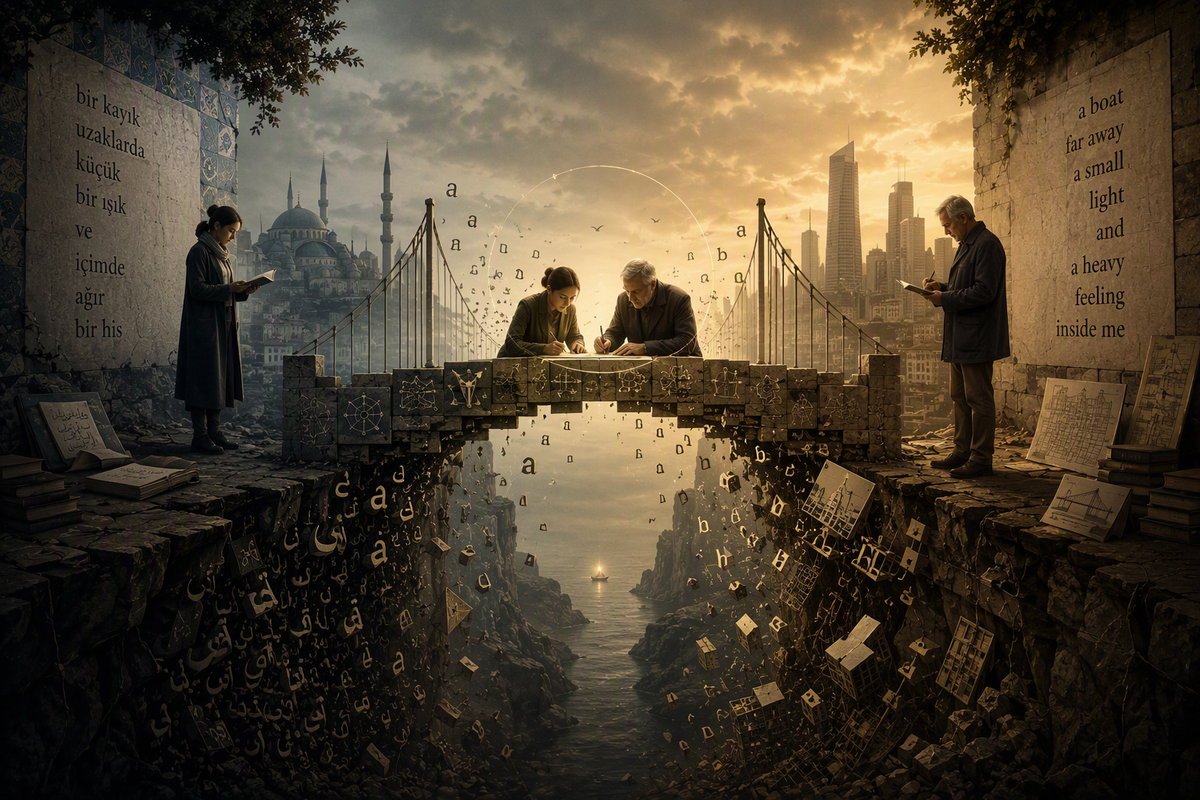
I've been reading Dirty August, a book of poems by the Turkish poet Edip Cansever, and the part that stayed with me wasn't a poem (I struggle with most poetry, but it was on a sale rack in my local bookshop!). It was the translators' note at the end, on the process of translation itself. They write about how hard it is to carry something of deep meaning from one language into another, and how much harder still when the two languages are built on different foundations.
Turkish is a case apart; in the twentieth century it was deliberately reformed, its Arabic and Persian words pruned out in the name of national purity, so a translator is working not only across a gap but across a language that has had some of its own richness designed out of it. The translation was done by two people, a father and daughter, because neither could have done it alone; one held the Turkish, the other could make it resonate in English.
I started to think this is our work too. Not the metaphor every architect reaches for, translating between the business and IT, but something more challenging underneath it.
The first thing the note makes plain is that translation is editorial, not transfer; the translator must make choices: keep this, drop that, lean on the image because the diction won't come across, and every choice adds or loses something. The meaning that arrives is partly made, not just moved. Meaning never moves across intact; the translator decides what the receiving side can afford to lose. We are moving meaning and sometimes choosing the losses.
The difficulty scales with structural distance, not vocabulary. A missing word can be worked around; a mismatched grammar cannot. I didn’t realise this until I started looking; Turkish is a very different language in its roots. Turkish holds a whole clause in a single word and lands the verb last, so the shape of a thought differs, not just its labels.
Vocabulary can be managed, and that has costs. The Turkish reform pruned the language on purpose and lost centuries of meaning with it; within a generation, people struggled to read their own founding speeches. Organisations run the same programme when they retire the old terms as legacy; the new words are cleaner and carry less memory, and the loss stays invisible until you need what the old words knew. Sometimes, of course, this retiring of language isn’t targeting pruning; it is what happens when people leave, and communities are reformed.
Constraint then shapes what gets made next. Cansever's generation, writing in a deliberately thinned language, moved the weight onto imagery and strange syntax, and the richness found another route. People do this in organisations too, when the official vocabulary can no longer hold real meaning, the meaning migrates into stories, side conversations and workarounds, and an architect who only reads the official language misses where it now lives.
So the translation work is paired, in the book and in organisations. The two translators were Julia Clare Tillinghast and her father, Richard Tillinghast, a poet with ten books to his name. Julia had lived, worked and studied the language in Istanbul; Richard had spent a lifetime making poems in English. One held the source, the other could make the target resonate, and the book exists because they worked it out between them. The person who holds the domain and the person who can craft the artefact are rarely the same, and the translation happens in the argument between them. Our job is less to be the translator than to convene that argument.
To put it in a line: the architect's task is not to carry meaning between worlds but to govern its losses; to know what was pruned, to notice where the richness has rerouted itself, and to hold together the people who can do the translating, because none of us can do it alone.