Community is many things, depending on where you stand

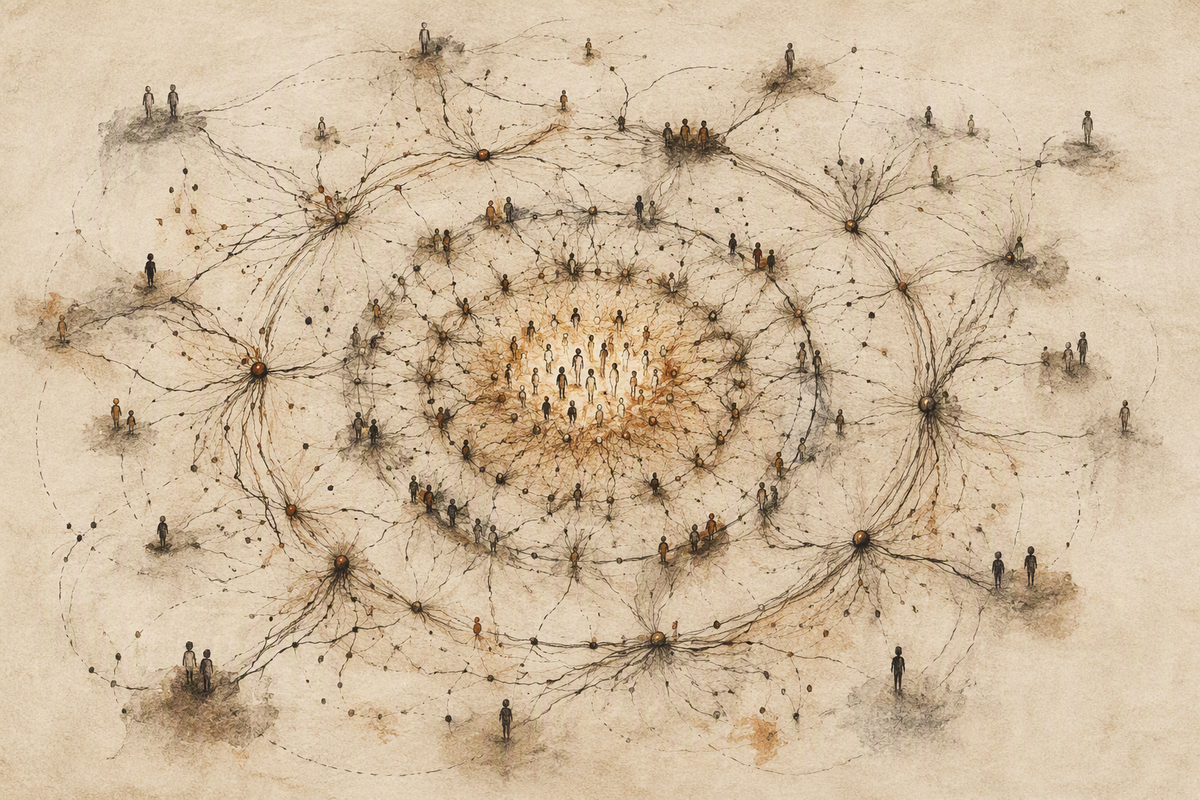
Community looks different depending on where you stand in it. This piece is about designing for all those positions, with a specific focus on the difficult but valuable edge cases.
Summary
Most community efforts fail slowly, not because people don't care, but because they are designed for those who already want to be there. The harder design challenge is for everyone else: the solo practitioner embedded at a client site with no backstop, the associate who never quite knows whether they're inside or outside the circle, and the experienced professional who identifies with the discipline yet has no reason to engage.
This paper argues that community is not a single thing. It is a different felt experience depending on where you stand, and until you understand that, you cannot design for it effectively.
The framework rests on two dimensions.
- The first is binding strength: what holds someone to a community. There are five layers, from shared fate at the core, through shared mission, shared practice, and shared interest, to shared curiosity at the outermost edge. The further out you go, the less obligation there is, and the more the community has to earn participation rather than assume it.
- The second dimension is structural position: the formal, contractual relationship an individual has with the community. The diagnostic power lies in the gap between the two. A solo consultant may be formally part of a practice yet feel like an outsider. An associate may be contractually peripheral yet invested. Map those two dimensions, and four situations emerge, each requiring a different design response.
The paper pays particular attention to two cases that most community designs underserve, which can be particularly prevalent in consultancies that rely on associates.
- The adapted loner: the solo practitioner who has learned, through repeated exposure, to manage alone and stop expecting support, invisible to the practice, improvising at the client boundary, and gradually narrowing what they are willing to attempt.
- The edge professional: someone with low affiliation who will not seek out community but might respond if the community comes to them in the right way.
It closes with the practical layer: a theory of change, a 90-day plan for small practices, a measurement approach that tracks signals and stories rather than KPIs, and a call to action for leaders, participants, clients, and those running small consultancies that rely on associates.
Many community efforts gradually fail
The people who turned up to the launch event were already in. The design challenge is everyone else.
This paper draws on experiences of building community across large-scale architecture functions, dispersed consulting practices, and looser networks of professionals who share a discipline but not an employer.
The motivation is not to improve close-knit communities; that ground is well covered. The goal is to understand how to reach those who are missed, with a particular focus on associates in small consultancies, because that is where the gap between community's potential and its actual design is most visible and most costly.
The people most worth reaching are often the hardest to design for:
- The person embedded alone at a client site, two time zones away from the nearest colleague.
- The associate who never quite knows whether they're inside or outside the circle.
- The experienced professional who identifies strongly with the discipline but has no reason to engage with it.
Community is not a single thing, and what it needs to do for each of these people is genuinely different. The paper works through that difference systematically, from the foundations of what community is, through a framework for assessing where people stand, to the practical question of what to do about it.
Community is a felt experience
You feel community before you can see the activities that sustain it, and you feel its absence the same way.
Walk into a practice where community is working, and you feel it before anyone tells you. There is a confidence that someone has your back. People ask for help without having to prove they don't need it first. Disagreement sharpens thinking without cutting anyone down.
Walk into a practice where it isn't working, and you feel it too. The low-grade anxiety of people who are busy yet not aligned. The loneliness of the solo practitioner carrying a risk they cannot fully identify. The cynicism of people who have learned to tolerate chaos because pushing for coherence costs too much.
The difference is not a programme, a portal, a knowledge-sharing initiative, or a town hall. It is the felt experience of three things: trust, unity, and solidarity.
Trust makes it safe to pause. Unity makes the shared story coherent. Solidarity means no one is punished for asking for context.
These are not soft outcomes. They are social capabilities that enable people to orient themselves and form a shared map of what matters, where the boundaries lie, who decides, and what good looks like. Orientation is ‘minimum viable sensemaking’: just enough shared context to act coherently rather than merely quickly. In the long term, coherence will win for those within the system and for those leading it.
The distinction matters because knowledge work cannot be industrialised, however much organisations try. When you treat it like a pipeline, i.e. decompose, hand off, time, and measure, you optimise for busyness rather than outcomes. The issues accumulate without you noticing, while the appearance of progress continues. Community, specifically the trust, unity, and solidarity that allow people to pause and make sense together, is what compensates for this. At scale, it is what allows people to push for adjustment rather than absorb chaos, adapt, and often adapt in ways that add to the overwhelm.
The tension is evident in large-scale architecture functions. At HSBC, where I led the architecture community, leadership framed it as a knowledge-sharing initiative: tell people to be more community-oriented, and results improve. Practitioners experienced it differently. Community was about how they felt when it was present and how that changed what they were capable of. That gap between the management view and the lived experience is where most community efforts fail.
Community is not one thing: the five binding layers
The difference is not just how strongly people are bound, but what is doing the binding.
The reason the community feels so different depending on where you stand in it is that the thing holding you to the community varies. The difference is not just in how strongly people are bound, but in what binds them.
There are five distinct binding layers, each with its own logic, primary risk, and design requirements.
Layer one: shared fate, high binding
- Close-knit teams, same employer, same project, same risk.
- Community here is nearly automatic; the work creates it. People are bound by mutual dependency: what happens to you affects me, so I have a direct interest in your success.
- The design challenge at this layer is not building community but sustaining its quality. Safety, coherence, and the rituals that enable disagreement without fracturing are what matter here.
Layer two: shared mission
- Same organisation or programme, but not always in the same room.
- People are brought together by a common purpose rather than by daily proximity. Dispersed consulting practices are here, as are large internal architecture functions, where people are embedded across different parts of the business.
- Shared fate is less noticeable as your colleague's bad week is not immediately your problem, and coherence requires deliberate design.
- Orientation mechanisms and visible leadership commitment carry the load that proximity would otherwise provide.
Layer three: shared practice
- Same discipline, different employers.
- No shared fate, no shared mission, but a common craft and common problems.
- Professional bodies, communities of practice, and internal guilds in large organisations operate at this layer.
- Identity is professional rather than organisational, which means the community must speak to the work itself, e.g. the puzzles, the standards, and the accumulated judgement of the discipline, rather than to organisational loyalty.
Layer four: shared interest
- Same broad field, variable depth of engagement.
- People who identify with the domain but loosely. They are not committed members; they are interested observers who may or may not become members. The community must repeatedly earn their attention, because nothing obliges them to stay.
- Most professional networks have a large population at this layer, and most community designs underserve them.
Layer five: shared curiosity, low binding
- The outermost ring.
- People who are adjacent, watching, and occasionally engaging. Not yet practitioners in the full sense, or not committed to the identity. They are the pipeline into layer four and sometimes the most generative voices in a community, precisely because they are not yet within the discipline's assumptions.
- The gradient from layer one to five spans three dimensions simultaneously. Obligation decreases, the intentionality required increases, and contribution becomes harder to sustain, not because people care less but because the natural incentives thin out.
The diagnostic
Knowing which layer someone occupies is useful but not sufficient. Within any layer, individuals experience the community very differently depending on a second dimension: how their structural position, their formal relationship to the community, aligns with their binding strength, meaning what really holds them there.
Structural position is the organisational or contractual reality. Employee, associate, contractor, member, follower, observer. Binding strength is the felt, experiential reality. Where on the five-layer spectrum does this person sit?
The diagnostic power lies in the gap between the two. When structural position and binding strength align, community design is relatively straightforward. When they diverge, that is where the interesting problems arise.
The four quadrants this produces are not abstract categories. They are recognisable situations that most community designers will encounter.
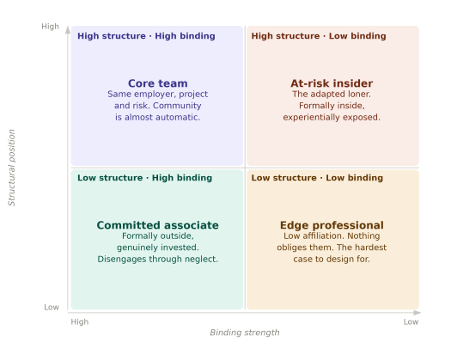
High structure, high binding: the core team
The people who are formally inside and committed. For them, community design is about quality and sustainability; keeping the rituals alive, preventing coherence from being eroded by pressure, and making it safe to maintain the behaviours that make the community real. These people do not need to be convinced; they need to be protected from the forces that gradually erode what they value.
High structure, low binding: the at-risk insider
The most common failure mode in dispersed work. A solo consultant embedded at a client site is structurally within the practice, with the same employer and community, but experientially they are often closer to layer three or four. Organisational cover is thin. The felt experience is one of low affiliation, even though the formal relationship says otherwise.
Community design for this person must compensate for the gap: the backstop, the buddy mesh, and the office hours that make it possible to ask for help without stigma. When it works, solo work feels supported rather than precarious. When it does not, the consultant absorbs the risk and can burn out in a way nobody anticipates.
Low structure, high binding: the committed associate
Associates, contractors, and engaged professional members who are formally outside but genuinely invested. The risk is that the organisation treats them as low-binding because of their structural position and neglects them. Associates disengage not by choice but through neglect. By the time anyone notices, the relationship has cooled and the goodwill that made them effective has gone with it. Community design for this group requires deliberate reciprocity: inclusion in context and decisions, clarity on ways of working, and recognition that is visible enough to make contribution feel worthwhile.
Low structure, low binding: the edge professional
The hardest case, and the most interesting. People who identify with the discipline but have no reason to engage with your community. Nothing obliges them to engage. They repeatedly choose whether the community is worth their attention. This is the population that most community designs give up on, or design for last. There are often significant value and risk in these situations, and community design should be a focus.
Designing for the edge: the hardest case
A community that waits to be found will not reach the people who most need it.
The adapted loner
There is a version of the distributed consultant that the framework describes accurately but does not fully capture. Structurally within the practice, experientially distant, the at-risk insider, but the diagnostic does not capture what years in that position do to a person.
The solo practitioner on a long assignment adapts. They learn to solve problems alone, absorb uncertainty without fuss, and project confidence to the client, regardless of what is happening beneath the surface. They stop expecting backup, because expecting it and not finding it is worse than not expecting it at all.
The self-sufficiency that develops looks, from the outside, like capability. It is, but it has been built on repeated exposure rather than collaboration and support. The person who has learned to manage alone has usually also learned to stop expecting anything different. That is the cost that isn’t visible. The practice loses visibility into what is happening at the client boundary: the risks being carried, the decisions being made without a sounding board, and the early signals that would allow intervention before something becomes a problem. Leadership on the supply side cannot manage what it cannot see, and the adapted loner has learned, through experience, not to make themselves visible.
This matters for community design because these people are unlikely to seek out community. They have learned either not to need it or to perform without it, which amounts to the same thing in practice. A community that waits to be found will not reach them. The distress, where it exists, is invisible: decisions made alone that should have been shared, risks absorbed that should have been escalated, and a gradual narrowing of what they are willing to attempt because there is no safety net visible to them.
There is a second, commercial dimension to this, rather than a personal one. The solo practitioner is the face of the practice at the client boundary. The client does not distinguish between the firm and the person; for them, the practitioner is the firm. Without active community connection, the practitioner is improvising: their own version of the firm’s positions, their own answers to questions that go beyond their remit, and their own judgment about what the practice would or would not do. Multiply that across ten practitioners on ten assignments, and you do not have a practice; you have a collection of freelancers with a shared logo.
Community is what makes them a team, even when they are never in the same room. It keeps them current with the practice, coherent at the client boundary, and able to represent something larger than themselves without having to invent it on the spot. That is both a welfare and a commercial argument, and the commercial case is often what secures the investment.
The design implication is specific. The solo practitioner will not come to the community; the community has to go to them. Proactively, lightly, in the rhythm of their work. Not practice updates pitched at the wrong level of abstraction, but something relevant to what they are likely dealing with right now. That requires the community to know enough about what each person is working on to make contact feel useful rather than administrative. That is itself a design question, and not a trivial one.
Low-affiliation professionals (layer four on the binding spectrum, with low structure in their formal relationship to the community) require a different design logic. Most community mechanisms assume some existing commitment: people engage because they want to, because their employer expects it, or because they have already decided the community is worth their time. But those conditions don’t apply here.
The design question is not how to build community for them. It is what would prompt someone with low affiliation to connect, even briefly. It is usually one of three things: they get something they cannot get elsewhere, they feel seen rather than processed, or they encounter something that makes the community feel worth the cost of participation.
This suggests that the mechanism is not rituals in the conventional sense. It consists of repeated, low-cost moments of genuine usefulness, with no upfront expectation of reciprocity.
The participation spectrum
Most community designs assume a binary: you contribute or you consume. That binary does not work at the edge. What works is a contribution gradient, a spectrum of participation in which even the smallest act of engagement counts and is treated as though it matters.
At the edge, contribution might appear in brief, simple ways, e.g., reacting or sharing something briefly. That is still a contribution. The mistake is treating it as less than writing a paper or running a session. The weight is different, but it is in the same direction.
This is not about lowering standards. It is about recognising that trust is built in small moments before it is demonstrated in large ones. The edge professional who reacts to a post, asks a question, or shares a brief observation may be testing the community. They are asking whether they will be seen here, whether their contribution will be treated with respect, and whether engaging will cost them more than it gives them.
If the answer to those questions is yes, they return. If it is no, they don’t, and they are unlikely to say why.
Richer signal at the edges
When someone at the edge engages, the community usually only knows that they did. A click, a reaction, a brief comment and that is a thin signal. It tells you someone engaged, but not why, what they were looking for, or whether they got it. Thin signals produce thin responses, and the person gets the sense they were registered rather than heard and valued, which is exactly the feeling that keeps edge members at the edge.
The design question is how to create conditions in which someone can, if they choose, say more specifically what landed and why. Not through a survey, which is the wrong approach, but through the texture of the community itself: a prompt that invites reflection, a response that shows someone has read their contribution, and a question that makes it easy to say a little more. When that works, two things happen at once. The community gains better insight into what it is doing for people, and the edge member feels seen rather than counted.
What this means in practice
The four situations the framework produces are not abstract categories. They are recognisable, and what community needs to do within each is different.
Together, the five binding layers and the diagnostic enable precision rather than generality. The four situations they produce are not abstract; they are recognisable, and the felt experience within each is distinct. What follows is a consolidation of what matters most in each and of what good looks like from the inside.
For close-knit teams, the risk is complacency and assuming that community exists because of proximity. What matters is safe dissent, shared cognitive load, and decisions that stick. When it is working, people challenge ideas without challenging each other. The felt experience is calm momentum.
For the solo practitioner in distributed consulting, the risk is isolation; no one to sanity-check a decision, no backstop when things wobble. What matters is compensating for the thinness of organisational cover without sacrificing autonomy. When it works, solo work feels supported rather than precarious. The consultant can ask for help without stigma and escalate early without fear.
For the globally dispersed professional, the risk is irrelevance; a community that does not consistently offer value for the cost of participation will gradually be deprioritised. What matters are repeated moments of genuine usefulness: insight that travels, conversations that are safe and substantive, connections that could not happen elsewhere. The felt experience when it is working: high signal, low ego, worth my time.
For the low-affiliation professional, the risk is invisibility; designing for people who are already engaged and treating the edge as secondary. What matters is making engagement easy enough that the cost-benefit calculation tips towards participation, and meaningful enough that it tips towards staying. The felt experience when it is working: “I was seen here, I got something I could not get elsewhere, and I might come back”.
There is a stakeholder the framework does not mention but whose experience of community is arguably the most important test of whether it is working: the client.
Clients do not see the community activity, but they do see the behaviour those activities produce. A consultant who never looks exposed, because they aren’t. A team that moves fast without reopening the same decisions. A practice that tells the truth early because the people in it have the backing to do so. These things are legible from the outside, even when their source is invisible.
The felt experience for the client when community is working: steadiness, joined-up thinking, and the confidence that comes from working with people who seem to know where they are going, even when the work is complex.
That differentiator is hard to replicate, which is why it is worth building.
What members owe the practice
A community designed entirely around individual needs will eventually hollow out. What sustains it over time is a different question: what are we collectively trying to build?
So far, everything has focused on what the community offers individuals at different levels. That is necessary; it is what brings people through the door, especially those on the edges who have no obligation to engage. But it is not sufficient, as a community designed entirely around individual need will eventually hollow out, because needs are met and people move on. What sustains a community over time is a different question: what are we collectively trying to build, and why does that require all of us?
The practice itself, the discipline, the craft, and the accumulated judgement of those doing this kind of work do not improve on their own. They improve because people invest in them beyond what their immediate job requires. That investment is the community's real product; not the support mechanisms, not the rituals, but the compounding of collective intelligence over time. A community that produces and holds that collective intelligence is valuable, although that is not always recognised.
This creates an obligation, though I don’t think it’s a heavy one. If you benefit from a practice others have built and maintained, you owe something back to it. Not necessarily in equal measure, the contribution gradient still applies, but in some form: presence, signal, an occasional piece of thinking shared, something that adds to the commons rather than simply drawing from it.
This is where the low-affiliation professional becomes a harder case than the framework alone suggests. Low affiliation, combined with comfort at the edge, "I'm here to do a job, not build community," is not a neutral position. It is a choice to benefit from something without investing in it. A community can tolerate that at the margins; it cannot be the norm without quietly becoming something less: e.g., a resource or a broadcast channel.
The design question is how to make that claim without driving edge professionals further away. The answer is probably identity rather than obligation. Not "you should contribute" but "this is what people who care about this discipline do."
That is a different ask; it appeals to the professional identity that brought them to the edge of the community in the first place. People who have chosen a difficult, demanding craft usually care about its future, provided the community makes it easy enough to show that they do and meaningful enough that it feels worth showing.
Making it real
Lead with feelings as they drive the behaviours you need.
The theory of change
People do not change because someone tells them to. Change accumulates over time as the context is better understood and new behaviours and connections stabilise. The mechanism is simple, even if the execution is not: rituals inform feelings, which inform behaviours, which inform outcomes.
A fortnightly patterns council sounds administrative, but when it runs well, people leave knowing their judgment is trusted, and their decisions will not be relitigated. That feeling of backing is what makes them willing to escalate early next time rather than absorbing the risk. The ritual created the feeling, the feeling changed the behaviour, and the behaviour changed the outcome for the client.
Lead with feelings, because they drive the behaviours you need. The first question to ask is not what mechanisms to put in place, but how you want people to feel when the community is present.
A 90-day Plan
Grand launches and heavy programmes are the wrong starting point. What works is small, visible, and humane: a set of rituals to reduce isolation, improve orientation, and create coherence under pressure. Start with 90 days, keep it light, and measure through signals and stories rather than KPIs. Scale what drives the best experiences.
For a distributed practice, a reasonable first 90 days might include:
- A buddy mesh for anyone on a solo assignment
- Occasional office visits, and regular and guaranteed drop-ins
- A soloists' circle monthly, confidential and free of agenda
- A fortnightly patterns council with short decision logs
- A weekly gratitude practice; three specific thank-yous
- A published code covering how the community welcomes, asks for help, disagrees, and repairs
- Protected time, two to four hours per person per fortnight, for community acts that are not squeezed into evenings.
After 90 days, review signals and stories, keep what people felt and retire the rest.
Measurement
Community value is often felt before it appears in hard metrics. The goal is not to measure everything but to make the invisible visible without creating a reporting burden.
Three signals are enough to start.
- First, whether help is sought early and without stigma is not just about the volume of requests, but about the quality of the response: kindness, practicality, and speed are signs that trust is present and functioning.
- Second, a simple felt-support pulse: a weekly one-tap check that tells you whether people, especially those working solo, are experiencing community as a real backstop rather than a slogan. This means leaders and those who maintain social cohesion make time to stay connected.
- Third, reuse with reference; whether patterns, decision logs, and working notes are cited in subsequent work rather than reinvented, is an indirect but meaningful sign that the community is producing assets people trust enough to use.
Stories complement signals. A monthly prompt, “What changed for you because of this community?” surfaces the moments that matter: the solo consultant who avoided a client escalation, the associate who raised a risk early because they knew someone would respond, and the edge professional who came back because something landed. Where appropriate, brief client observations are worth capturing too, as clients often notice steadiness and early truth-telling before any internal signal does.
The wider horizon
Get the foundations right and everything else becomes possible.
What has been described so far is the first of four layers in a broader community agenda; foundations. These are the mechanisms that create safety and coherence and directly reduce the risk of isolated, incoherent work. It is the right place to start because it addresses the most acute problems, i.e. isolation, exposure, and the people and process costs of people compensating and cohering.
The second layer is enablement: making it easy to participate and contribute. Community roles, communication cadence, simple contribution pathways, and lightweight knowledge curation. This is the infrastructure that enables easy engagement.
The third is practice growth: making the community a better practice, not just a nicer one. Peer learning, deep work habits, and the skills and beliefs that improve judgement under uncertainty. This is where the collective investment in the discipline begins to compound.
The fourth is amplification: making the community visible and valuable beyond its own boundaries. Thought leadership that is genuine rather than theatrical, external conversations that are safe and substantive, and a reputation that grows because it is earned rather than claimed.
The sequence matters because foundations create safety, practice growth that goes beyond aspiration, and amplification is not just about performance. Get the foundations right, and everything else becomes possible.
Conclusion
Design for the structure you have, not the commitment you assume in the people.
Community can deliver hard outcomes, but the route to those outcomes runs through the felt experience of trust, unity, and solidarity, attuned to where each person stands, not where you wish they stood. Design for the structure you have, not for the commitment you assume in people.
The framework in this paper gives you two things: a way of reading where people are, and a way of thinking about what they need.
- The five binding layers show what is holding someone to the community.
- The diagnostic tells you whether their formal position and their felt experience align or diverge.
- The gap between the two is where the design work happens.
Frameworks do not build communities; people do. The more useful question is what changes tomorrow, depending on where you stand.
If you lead a community, the question is not what programme to launch. It is what the people around you feel right now, and whether that feeling is one they can work from. Find out, then remove what is making it harder.
If you are a participant at any level, in any role, the question is what you are taking from the community and what you are putting back. The participation spectrum means the bar is low but not zero. The practice improves because everyone involved invests in it.
If you are a client, a commissioner, or someone who works alongside people embedded in communities you never see, look beyond the individual talent that produces moments of brilliance because community produces something more serene and more valuable. Collective confidence that doesn't depend on who is in the room. Resilience that doesn't require heroics. No surprises, not because nothing goes wrong, but because the group catches things early and says so. You feel it as ambient steadiness, constant, easy to take for granted until it isn't there. That is community doing its work on your behalf. It is worth asking whether the people you work with have it.
If you lead a small consultancy that relies on associates, the message is more specific. You are already paying for the cost of low community among associates who improvise at the client boundary, for goodwill that cools without anyone noticing, and for reputational risk that is invisible until it isn't. The question is not whether to invest in community, as you are already paying for its absence. The question is whether to make that investment deliberately.
You do not need a programme, and a small consultancy does not need a dedicated community manager. It needs a small number of deliberate habits, led by practice leads, that make associates feel inside the circle rather than orbiting it. That is achievable in 90 days with modest effort and no new infrastructure.
If you believe your model is better than the usual one, that you do things differently, and that your associates are more than a zero-hours bench, community is how that belief becomes visible to the associates who are deciding whether you are worth their best work and to the clients who will feel the difference.