Preface

What this book is and isn’t
This book is not for everyone, and it is worth saying that at the start.
It is not for the expert in systems thinking who has read Beer and Senge and can cite the relevant literature without pausing (I can't, by the way!). It isn't for senior consultants who already have strong views on what works and what doesn’t and are looking for validation. It is not for the academic who needs a rigorous theoretical framework before they can engage with an argument, although to perform a proper cross-sector study on this would be an amazing venture.
If that is you, you are welcome to read on, but you may find it frustrating.
There are things in here that are not new, combined with things that are not yet fully proven, written by someone who is neither a systems theorist nor a management scientist. I am a practitioner. I have spent my career inside large organisations, watching things work and watching things fail, and trying to understand the difference. This book is my attempt to describe something I kept seeing that I could not find described in a single place anywhere else.
It is written for people earlier in that journey.
If you are early or mid-career, working in or around large organisations, and you have been given frameworks and structures as the primary answer to organisational problems, this book is for you. If you are good at your work, and you believe in the value of what you do, and you have started to notice that the frameworks keep disappointing in ways you cannot fully explain, then this book is for you. If you have sat in a room where a new operating model was unveiled and felt, without being able to say why, that something important was missing, this book is for you.
It is also for the leaders who commission that work and live with its results, and for the practitioners who do it and want to do it better.
If it just makes you question what you see around you in terms of commissioned work, the motivation, the expected outputs, and the anticipated impact, then it has achieved something.
Two tribes
There are two tribes in the world of organisational change, and they do not talk to each other as much as they should.
The first designs structures, operating models, capability frameworks, value streams, and governance architectures. They are trained to think in systems, to find the coherent design that will produce the right behaviour. They are good at making complex things legible. They tend to underestimate how much the underlying human system will adapt to whatever they design.
The second works with people, coaches, organisational development practitioners, and culture change specialists. They understand that behaviour is not changed by restructuring alone, that people need to be brought along, that the human dimension of change is where most of the difficulty lives. They tend to underestimate how much the formal system shapes the conditions in which people can or cannot change.
This book tries to occupy the space between them. Not to replace either because both are necessary, and the best practitioners of each already understand more of the other's territory than their job titles suggest. The book suggests there is a layer that sits between the formal design and the human system, which both tribes tend to overlook. In the book, I have called it the fabric. Looking back over the last few months as these thoughts stabilised, I cannot recall where that came from, whether I invented it, or if it is lifted from another work. I do not pretend to own it as a name, and if someone out there does, I hope they don't mind me building on it.
I should briefly say what I mean by "fabric" before the book does it properly.
Fabric is not culture, though it shapes culture. It is not governance, though it includes some of the same mechanisms. It is not leadership, though leaders are its most important carriers. It is the connective tissue of an organisation in motion: the rhythms, behaviours, relationships and informal conditions that determine whether a formally designed system functions, or whether it becomes, as so many do, an artefact that the organisation works around rather than within.
I came to this idea slowly, through accumulated experience of watching operating model work disappoint (and some of that was my own work), and community work succeed in ways that nobody had quite planned for. I haven't seen an organisation fail because its formal design was wrong. I have seen many that were failing because the underlying conditions had eroded or had never been built in the first place.
That is a different problem, and it requires different work.
There is one more thing worth mentioning before the argument begins, as it explains how the book works and what it is trying to do.
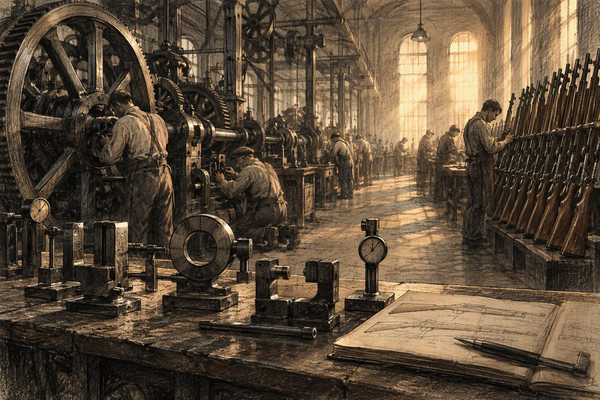
Most organisational thinking inherits a metaphor without knowing it. The organisation as machine: efficient, designable, optimisable, with inputs and outputs and parts that can be replaced when they fail. It is not a metaphor anyone chooses consciously. Because it feels like reality rather than a frame, it shapes what leaders notice, what gets measured, what feels like a legitimate problem, and what kind of solution feels like the right response.
When something goes wrong in a machine, you fix it. When performance drops, you optimise it. When people don't behave as designed, you retrain or replace them. The machine metaphor makes all of these feel obvious. It crowds out a different set of questions entirely: are people oriented, are the conditions right and is the fabric holding?
This book is not primarily an argument. It is an attempt to offer a different set of metaphors and to present them repeatedly from different angles until they start to feel more natural than the ones you arrived with. The tended ecosystem rather than the engineered machine. Architecture as cultivation rather than construction. The junction that coordinates without a controller. The trade routes that carry knowledge across a landscape that are maintained through use. These are not illustrations, they are moments to think differently, and this is the precondition for acting differently.
George Lakoff and Mark Johnson, writing about how metaphors shape thought, observed that metaphors do not just highlight certain aspects of a concept; they hide others. The machine metaphor highlights efficiency and design while hiding conditions, relationships, and the irreplaceable knowledge that leaves when people do.
You cannot argue someone out of a metaphor they do not know they are using. The frame has to be replaced, not refuted.
This is one of the behaviours that architects fail to see and which leads them, me included, to a lack of success in convincing senior leaders to do something different; we have a habit of pointing out failure in others' logic, although I am not sure this book will tackle that.
Replacing this frame is what this book is trying to do, and it is worth highlighting because the benchmark for whether the book has worked is not whether you can recite its arguments. It is whether, by the end, you find yourself reaching instinctively for a different set of images when you think about the organisations you work in or lead. Whether the machine metaphor starts to feel like the strange one. Whether tending feels more natural than fixing.
If it does, the book has done its job. If you finish it still thinking primarily about how to fix or optimise the organisation, it hasn't, and that is worth knowing too.
A word about what this book is not claiming.
It is not claiming to have rewritten the textbooks on systems thinking. People far more qualified than me have spent careers on that territory, and I am drawing on their work rather than superseding it. Where I have borrowed ideas, from Beer, from Marquet, from Brand, from others, I have tried to say so, and to be clear about what this book adds rather than what it reproduces.
There is no shortage of knowledge about how organisations work and why they fail. The science of human behaviour, of systems, of communication, of decision-making, it is well-developed, often well-written, and more accessible than it has ever been. Some of it is brilliant, but the knowledge doesn't become practice. Leaders read it, recognise it, and return to the same playbook on Monday.
This is not a failure of intelligence or commitment but a failure of conditions. The knowledge tells people what good looks like. It rarely creates the circumstances in which good becomes possible or safe enough to try. Most of it is absorbed through the same inherited frame, the organisation as a system to be optimised, which filters out the parts that would require a different way of thinking entirely.
This book is not adding to the pile. It is trying to occupy the gap between what we already know and what we do, and to argue that the gap is not closed by more knowledge, but by different conditions. That is a more specific and more practical claim than it might sound, and it is what the rest of the preface and the rest of the book are trying to make good on.
I will not claim that structure doesn't matter, as it does. The operating model is necessary, and the capability model has its place. The argument is not that these things are wrong, but that they are incomplete and that the missing piece is specific enough to be built.
I am not claiming to have solved this. Part Four is an honest appraisal of where I am; it is the least finished and serves as a starting point. The practice this book seeks to establish is still being developed, and those who recognise the problem are best placed to help build what comes next.
One last thing
… before the book begins.
The opening chapter is a story. It is drawn from a real experience, in a real organisation, with real people whose energy, friendship and generosity I will not forget. I have changed enough details to protect the institution and the individuals (although many of you will know who that organisation is), but the essential truth of it is as accurate as memory allows.
I tell it because arguments are easier to receive when you have first felt something. The question the story leaves is the question this book is trying to answer: can it be built deliberately?
I think it can.